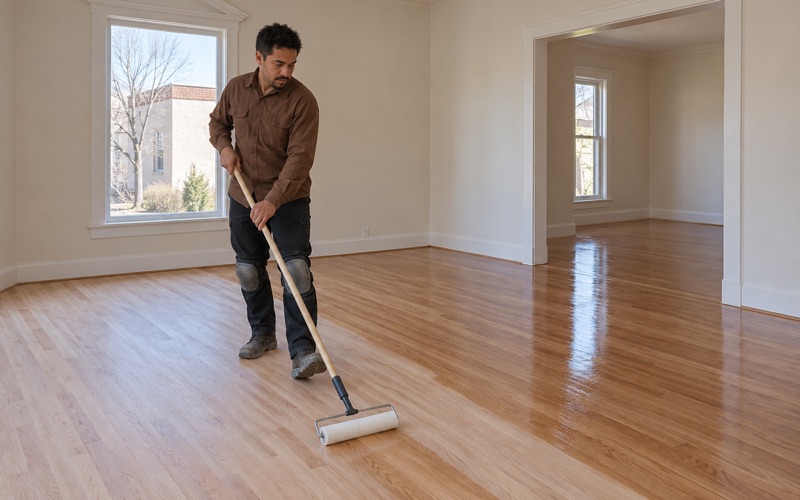
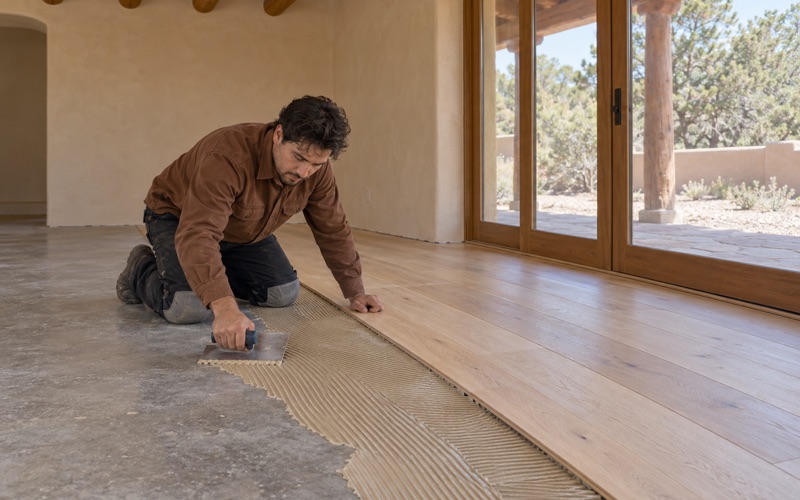
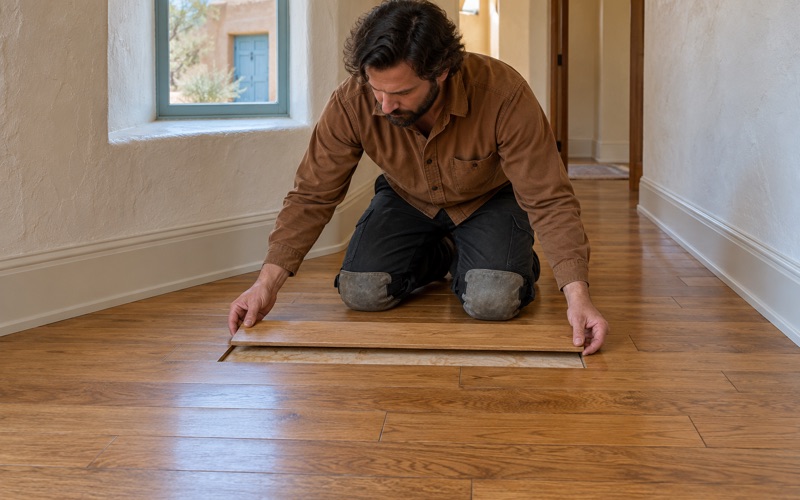
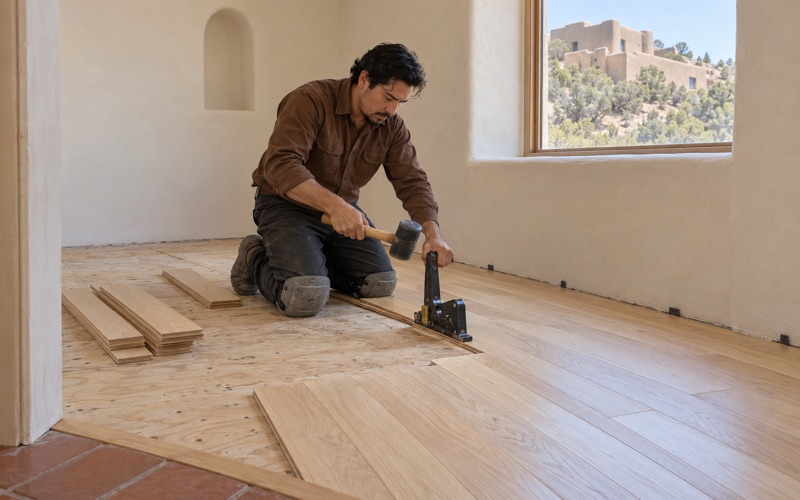
Santa Fe Wood Flooring brings more than 20 years of work to wood flooring in Santa Cruz, from sanding and refinishing a tired living room to replacing damaged boards and installing a new floor. Most of the homes we are called to here are older, and many are rentals, so a job usually starts with what the existing wood can still give rather than what to tear out.
We measure before we recommend. Moisture readings in the boards, the subfloor and any concrete are written down before any material is ordered, and the estimate you receive lists each step on its own line. That way the reasoning behind the price is on paper, not in our heads.
The sections below cover what sets this community apart, how the age and mix of its houses shape floor work, and what to expect once a project gets underway. If you already know what your floor needs, the last section explains how we plan and schedule it.
New Mexico’s Second Villa and a Registered District
Santa Cruz is a census-designated place in Santa Fe County, a half-mile east of Española, and it has never been incorporated as a city. Its roots run deeper than those of most towns in the state. Diego de Vargas founded the Villa Nueva de Santa Cruz de la Cañada in 1695, and one history describes it as upriver New Mexico’s second formal municipality, the second villa the Spanish established in New Mexico.
Founded in 1695
The National Register nomination for the site states that the village was established at its present site in October 1695. Sixty Spanish families settled the new villa first, and they were joined that October by 44 more families who came from Zacatecas. Permission for a new church was proclaimed in 1733, and the building went up through the 1730s and 1740s.
What the 1973 listing records
La Iglesia de Santa Cruz and the Site of the Plaza of Santa Cruz de la Cañada were entered on the National Register of Historic Places on August 17, 1973, under reference 73001148. The nomination, prepared by James H. Purdy of the State Records Center and Archives, describes a district of 4.5 acres. It lists present uses that include agricultural, commercial and private residence alongside the church itself.
Quoting a 1776 inventory, the nomination records that the church has adobe walls more than a vara thick, a Spanish measure equal to 32 2/3 inches. The same document describes a roof carried on heavy cross timbers and wrought beams running the length of the building, and the ceiling over the nave had to be replaced in 1783. Today most structures in the district are cement-plastered in an adobe shade of brown, and South McCurdy Road runs through it.
Our part in all of this is small and specific. We work on the floors inside homes in the community, and when a question reaches beyond the interior of a house, we point you to Santa Fe County rather than guess at an answer.
Looking for wood-flooring closer to Chimayo? See Chimayo Wood-Flooring.
A Housing Stock Mostly Built Before 1980
The American Community Survey counts roughly 115 housing units in Santa Cruz, a small sample with a wide margin of error, so we read the figures as a shape rather than an exact tally. About 67 percent of those units were built before 1980. The 1970s lead by a wide margin with 44 units, about 11 percent of the stock dates to 1939 or earlier, and the estimate shows no units built in 2010 or later.
What an older floor asks for
A floor that has lived through four or five decades has often been sanded, stained or covered at least once. Before we recommend a full refinish, we check how much wood is left to work with, because every sanding takes some of it. Where there is room, we run a measured grit sequence with a drum sander and edger; where there is not, a screen and recoat or careful board replacement may serve the floor better.
Older floors carry older problems, too. Orange oak from an aging finish, sun fading near windows, peeling polyurethane and cupping where water once sat are common, and each one has a different fix. We explain which problem you actually have before we price the work that solves it.
Color is part of the same conversation. Many owners of older houses want to lose the yellow cast of an old finish, and some species take stain unevenly, so we test a sample board in your own light before committing to a color. A clear waterborne finish or a hardwax oil finish keeps a floor closer to the natural tone of the wood.
Dry air and aging boards
Gaps between boards, checking and splitting along the face, and winter squeaks that return every year usually trace to humidity before they trace to carpentry. We read the moisture content of the wood with a wood moisture meter, compare it to the equilibrium moisture content the house holds, and give you a written indoor relative humidity target. If a whole-house humidifier would help, we say so plainly.
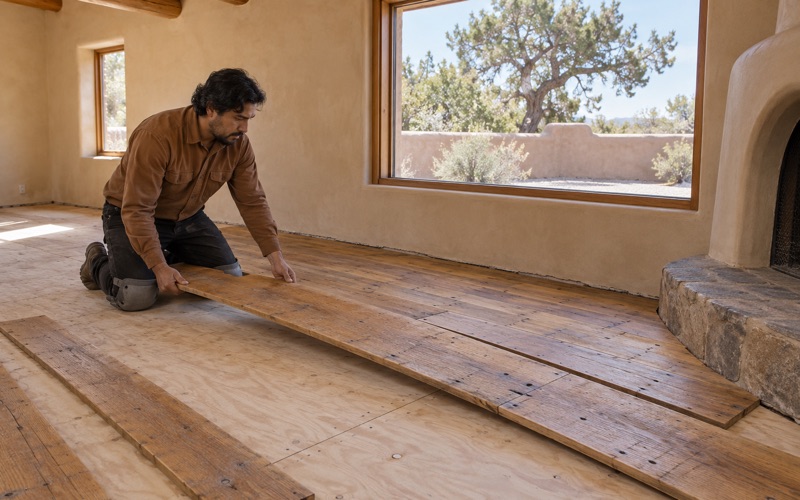
Reclaimed boards and wide plank pine get the same attention. Wood milled somewhere wetter will shrink in this climate, so we let it acclimate inside the house until the readings settle. That step keeps new boards from opening up in their first winter.
Lead-safe sanding
Many houses here predate 1978, and on any of them we do not assume an old finish is free of lead. Before sanding, we set up containment, follow lead-safe practices under the EPA Renovation, Repair and Painting rule, and run a dustless sanding system with careful cleanup afterward. New finishes are chosen to meet the federal VOC limits in 40 CFR 59 Subpart D, with low-odor waterborne polyurethane for families who stay home during the work.
Detached and Attached Houses, Owned and Rented
The ACS estimates 55 one-unit detached houses in Santa Cruz and 39 one-unit attached houses, so attached homes make up about a third of all units. Those attached houses are almost all rented, with 33 renter households counted among them. Renters occupy about 72 percent of occupied homes overall, while the 29 owner-occupied homes in the estimate are all detached houses.
Attached rentals between tenants
For the owner of an attached rental, floor work usually happens in the gap between one lease and the next. Pet urine stains, worn lanes by the door, water marks near the kitchen and a scratched finish make up the usual list. We write itemized estimates that separate normal wear from damage, which helps a landlord itemize deposit deductions under New Mexico’s 30-day rule.
A shared wall also means a neighbor on the other side of it. We keep sanding to daytime hours, contain dust to the unit we are working in, and hand you a written cure schedule so the unit can be shown or leased again on a known date. Short-term rental owners get the same schedule, built around their bookings.
Detached houses and older heating marks
Owners of detached houses tend to take on longer projects: a full refinish, new wood in a room that had carpet, or a repair after a leak. Older houses often carry an abandoned floor furnace opening or holes left by a wall heater. We patch those with boards woven into the surrounding floor, staggering the joints so the repair blends in instead of reading as a square filler piece.
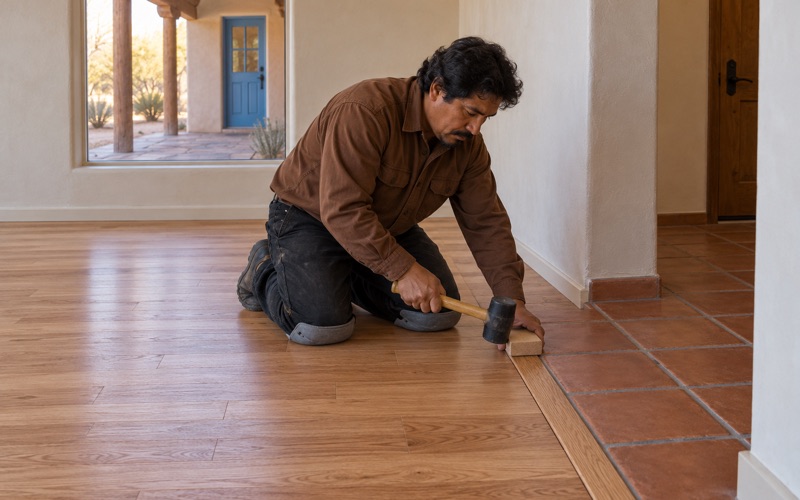
Where wood meets Saltillo tile, brick or flagstone, we plan the transition before the first board goes down. A flush joint, a reducer strip or a T-molding each has its place. The goal is no lip to catch a toe and no gap to collect grit at the doorway.
Planning Floor Work in Santa Cruz
Every project begins with a visit to the house. We walk the rooms, take moisture readings in the wood, the subfloor and any concrete, and write them down before material is ordered. Those readings come back to you with the estimate, so the numbers behind our recommendation are in your hands.
New wood and radiant heat
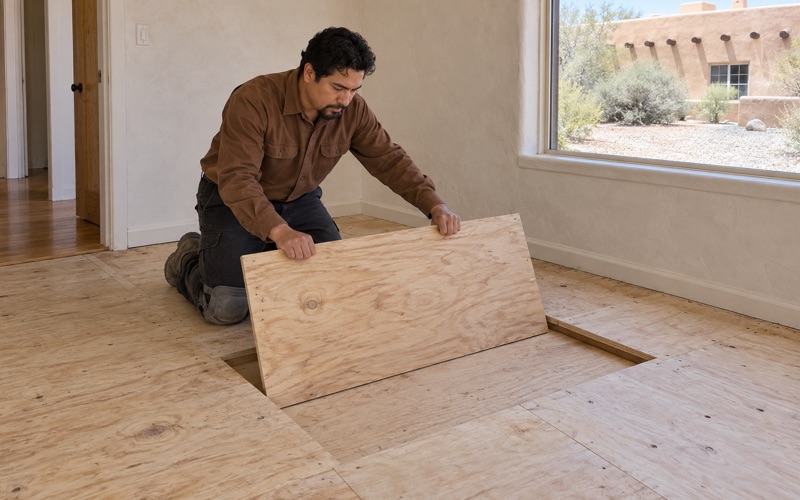
When a room needs new wood, the choice is usually between solid hardwood and engineered flooring. Engineered core construction holds its shape better as indoor humidity swings, and a thicker wear layer leaves room for a future sanding, while solid white oak, red oak or hickory can be nailed down over a sound plywood subfloor. The Janka hardness rating is a fair guide to how well a species stands up to dogs and furniture.
If the house has hydronic radiant floor heating, we plan the job to the NWFA radiant heat guidelines. They cap the floor surface at 80 degrees Fahrenheit, limit temperature changes to 5 degrees a day, and rule out setback thermostats, so we go over your heating settings before the wood goes down. Over concrete, we run a calcium chloride moisture test or an in-situ relative humidity test before choosing a vapor retarder and adhesive.
Water damage and insurance
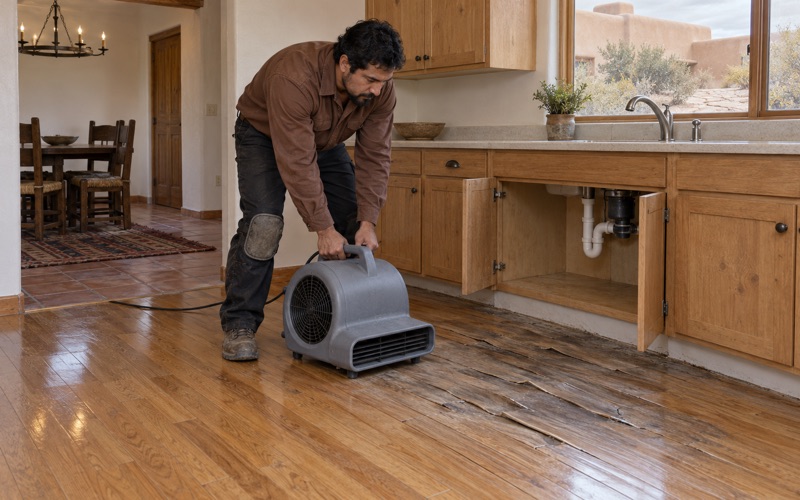
If a floor is cupped, crowned or buckling after a leak, we trace the water to its source first, including a leak in a radiant heat line. We document the damage with photos and moisture readings an adjuster can use, then replace boards only after the subfloor has dried out.
Weather and timing
Santa Cruz falls in the National Weather Service Española Valley forecast zone. Seasonal shifts move indoor humidity, so we time acclimation and refinishing to the readings in your house rather than to the calendar. A waterborne finish usually lets a room return to light use sooner than an oil-modified one, and we put the date furniture can go back in writing.
Inside the house while we work
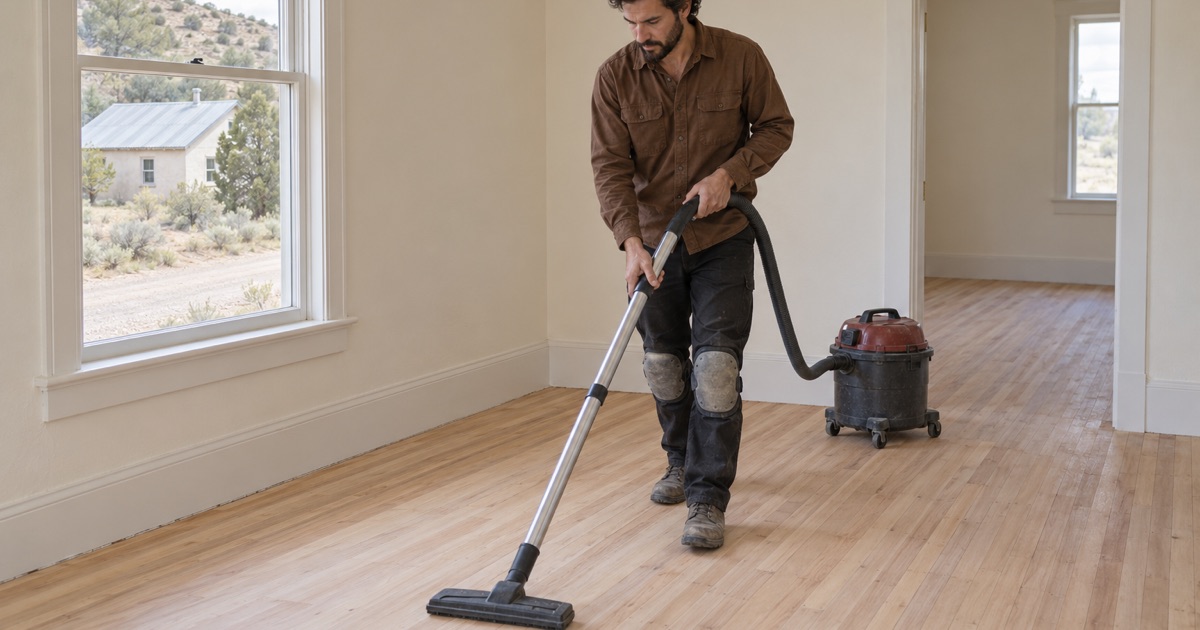
Rooms outside the work area are sealed off, and our sanders feed straight into vacuum collection so dust does not drift down a hallway or through a shared wall. Before the first coat of finish, we look over each room with a light held low to the floor, since a sanding mark is easy to fix at that stage and costly after the final coat. Anything we uncover that changes the scope, like a soft section of subfloor, is shown to you and written into the plan before work continues.
Whether you own an attached rental that needs to turn over quickly or a detached house with floors worth saving, the first step is the same. Call Santa Fe Wood Flooring to set up a visit, and we will measure, explain what we find and give you a written plan for the work.
- 20+ Years Experience
- Written Moisture Readings
- Itemized Written Estimates