Santa Fe Wood Flooring brings more than 20 years of work to wood flooring in Santa Clara Pueblo, and on this page we focus on the problem that decides how most of those jobs go: water. A floor that has taken on water can often be saved, but only if someone finds where the water came from, measures how far it traveled, and dries the wood before anyone sands, stains or tears out boards.
We install solid hardwood and engineered floors, handle refinishing and board replacement, and take on repairs after leaks and flooding. On any wet floor our first visit is about readings rather than recommendations. We record the moisture content of the boards, the subfloor and any concrete underneath, and we photograph what we find so the record exists before the house changes.
The sections below explain why water is the right starting point here, how we assess a floor after it gets wet, and how we decide between drying, repairing and replacing. They close with the questions we settle with a household before a crew arrives.
Floors in a Watershed Changed by Fire
The 2011 Las Conchas Fire did not reach into the Pueblo’s houses, but it changed the ground that drains toward them. That shift is what makes flooding, rather than fire, the practical concern for a wood floor here.
What the Governor’s Testimony Recorded
In testimony dated February 7, 2012, Governor Walter Dasheno said that more than 16,000 acres of Santa Clara forest land burned and that no homes were burned. He also said that over 50 percent of the Santa Clara Pueblo watershed burned and that the soil had become what soil scientists call hydrophobic. The result, in his words, was a four-to-eight-fold increase in runoff and sediment and debris flow into Santa Clara Creek.
He went on to say that the channel through the Pueblo no longer had the capacity to safely pass large post-fire flows, and that hundreds of residential structures, along with several public structures, were at risk from flood and debris flows. He described a rain of just 1 inch over 8 hours that led to intense flooding and an emergency evacuation. We cite the testimony directly because it is the Pueblo’s own account, not a forecast of ours.
The Canyon Dams and What Followed
The Pueblo owned four significant-hazard dams in Santa Clara Canyon, Tschicoma, Nanaka, Weinpovi and Pin Dee, administered by the Bureau of Indian Affairs. Monsoon debris flows in July and August 2011 filled their reservoirs and plugged the outlet works at all four. On August 21, 2011, three of them, Nanaka, Weinpovi and Pin Dee, were overtopped, with extensive damage in the channel below.
The governor named the Bureau of Indian Affairs, the U.S. Army Corps of Engineers, the U.S. Forest Service, FEMA and NRCS as partners in post-fire flood mitigation. None of that is flooring work, but it explains why a household here may reasonably plan for water reaching the floor at some point.
What Runoff Means Inside a House
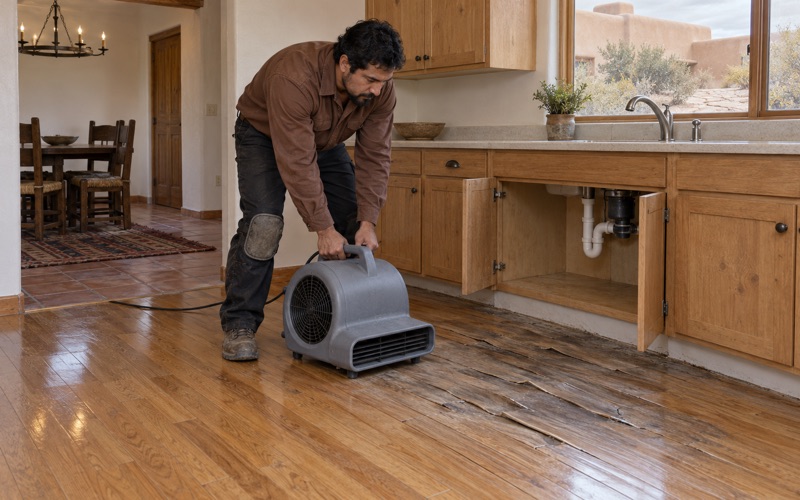
Floodwater carrying sediment behaves differently from a clean leak. It leaves silt in board seams and under trim, it can soak the subfloor from below, and it rarely dries evenly. A floor can look flat a week after the water recedes while the underside is still wet enough to cup or buckle later.
That delay is why we never judge a flooded floor by its surface. The readings underneath tell us far more than the finish on top.
Sediment also matters for the finish. Grit left in seams acts like sandpaper under foot traffic, and fine silt can bond into a softened finish as it dries. We clean seams and surfaces before deciding whether the finish itself is damaged or only dirty.
Looking for wood-flooring closer to Santa Cruz? See Wood-Flooring Services in Santa Cruz.
Assessing Wood Floors After Water Gets In
Water reaches a floor in more ways than flooding. Before we talk about repairs, we work out where the water came from, how far it spread, and whether it is still coming.
Tracing the Source First
A wet floor near an exterior door after a storm points one way, while a damp patch in the middle of a room points another. We check plumbing runs, appliance lines, window and door thresholds, and, in homes with hydronic radiant floor heating, the heat lines themselves, since a leak in radiant tubing can wet a floor from underneath with no visible drip. Drying a floor while the source is still active only resets the damage.
Once the source is found and stopped, we map the moisture with a wood moisture meter across the affected area and past its edges. Wet wood usually extends farther than the stain does, and the map tells us where drying has to reach.
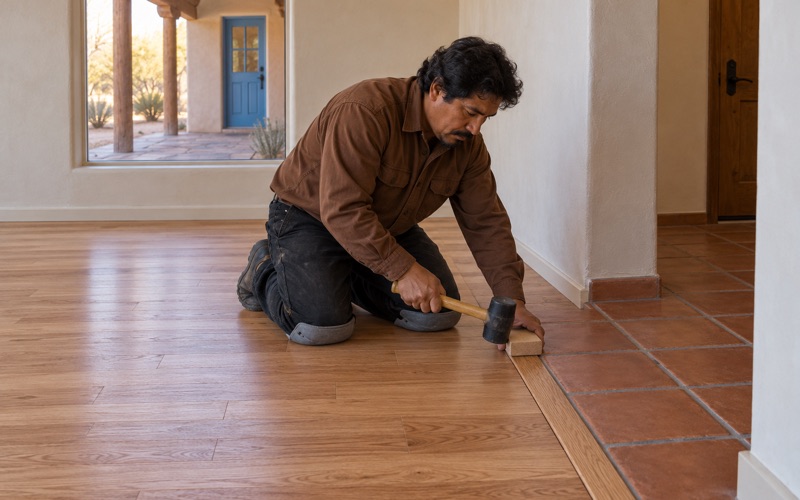
Doorways deserve a close look, since that is where outside water usually arrives first. Where wood meets Saltillo tile, brick or flagstone at a threshold, a poorly planned transition can leave a gap that lets water run under the boards. When we repair those floors, we rebuild the transition so the joint is tight and the change in height is handled with a reducer strip or T-molding rather than an open lip.
Reading Cupping, Crowning and Buckling
Cupping, where board edges sit higher than their centers, usually means moisture is coming from below. Crowning, the reverse shape, often shows up when a cupped floor was sanded flat before it dried and then settled back. Buckling, where boards lift off the subfloor entirely, signals that the wood swelled past the room its expansion gap allowed.
Each shape points to a different next step. A mildly cupped floor may flatten on its own as it dries back toward equilibrium moisture content, while a buckled floor has usually broken its fasteners and needs boards lifted.
Documentation an Adjuster Can Use
We document water damage with photos and dated moisture readings from the first visit forward. If you file an insurance claim, that record shows the adjuster what was wet, how wet, and how the readings changed during drying. It also protects you if the question later becomes whether the damage came from one event or several. We keep copies, so a return visit months later can be compared against the first.
Drying, Repairing or Replacing Boards
The order matters more than any single product. Dry first, reassess, then decide what the floor actually needs.
Drying Before Anything Else
We do not sand, fill or refinish a wet floor. Sanding a cupped floor flat while it still holds water is the usual cause of crowning a few weeks later, and filler packed into swollen seams cracks out as the boards shrink back. We track readings in the boards and the subfloor until they settle near the level of dry wood elsewhere in the house.
Drying time depends on how long the water stood, what the subfloor is made of, and how much air movement and dehumidification the house allows. We cannot promise a date on the first visit, but we can tell you which readings we are waiting for and check them on a schedule you know in advance. When the numbers level off, we reassess the shape of the floor before choosing a repair.
Where there is concrete under the floor, it gets its own tests, a calcium chloride moisture test or an in-situ relative humidity test. Concrete can hold water long after the wood above it reads dry, and a floor reinstalled over it without a proper vapor retarder can pick that moisture back up.
Weave-In Repair or Full Replacement
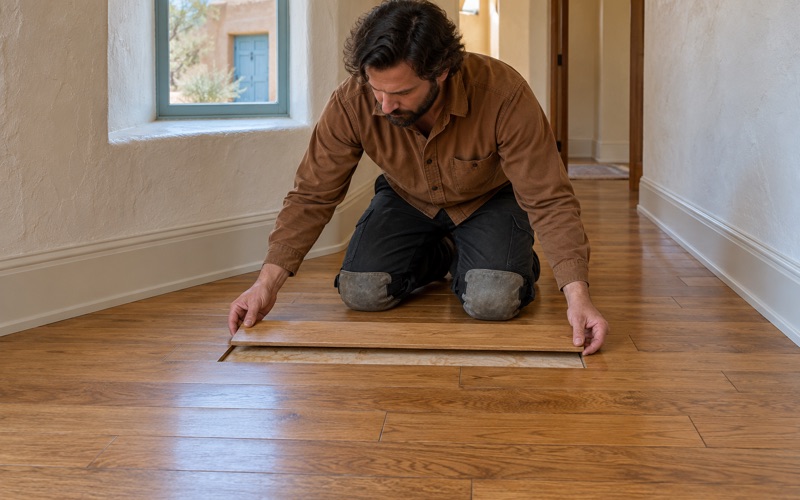
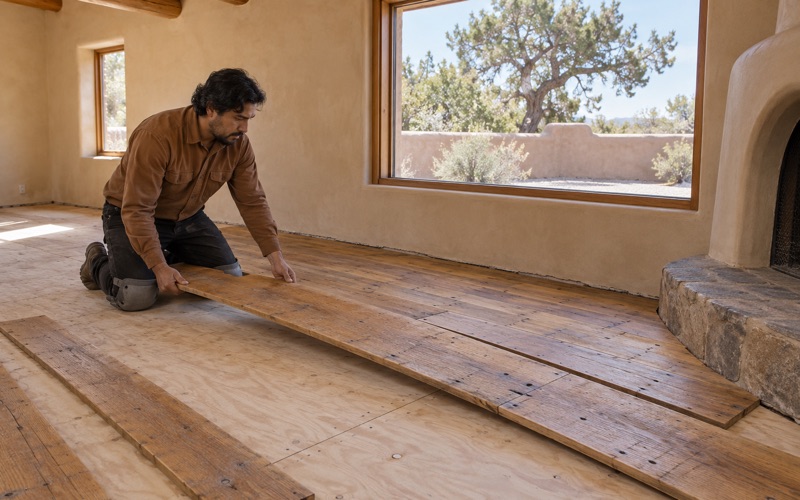
When damage is limited to part of a room, we often cut out the affected boards and weave new ones into the existing floor, staggering the joints so the repair does not read as a patch. We match species and width, acclimate the new stock in the house, and then sand and refinish the area so the color blends. This is often far less disruptive than replacing a whole floor.
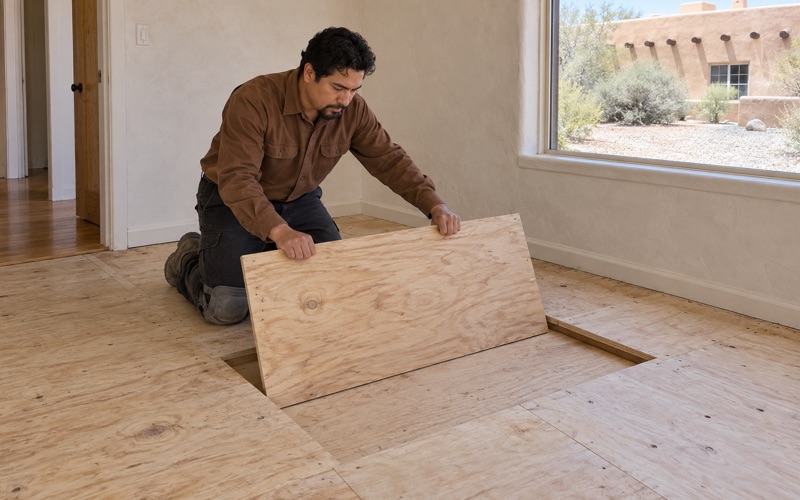
Replacement makes sense when the subfloor itself has failed, when boards have split or delaminated, or when sediment has worked deep into seams across a large area. In those cases we pull back to sound material and rebuild from there.
Choosing Floors That Can Be Dried and Restored
For a floor in a house that may see water again, we talk through which products recover best. Solid hardwood with a generous thickness can often be dried and sanded more than once, while an engineered floor with a thick wear layer offers similar refinishing room with less movement. Thin wear layers and some floating products are harder to save once water gets under them.
Where wood goes over radiant heat, we follow the NWFA radiant heat guidelines, which cap the floor surface at 80 degrees Fahrenheit and limit temperature changes to 5 degrees a day. Those guidelines rule out a setback thermostat for wood over radiant heat, so the system has to run steadily. A floor that is not being cycled hot and cool also recovers more predictably if it ever gets wet.
Questions to Settle Before Work on Pueblo Land
Santa Clara Pueblo is a federally recognized tribe, and the Pueblo sits in Rio Arriba County along NM 30. We ask a few questions before scheduling so the job fits the household and the place.
Who Should Be Part of the Decision
Governor Dasheno described Santa Clara as a Self-Governance tribe, one of only two in New Mexico. We do not assume how outside rules apply to work on the property. Before a crew is booked, we ask the homeowner who should be consulted and follow that answer, and if anything is unclear we wait until it is settled.
Older Houses and Long-Term Owners
Census estimates for the Santa Clara Pueblo census-designated place count 354 housing units, with 70.3 percent built before 1980, though the margins on those figures are wide. When a water-damaged floor in a house built before 1978 needs sanding, we follow lead-safe work practices before any old finish comes up. The same estimates count 62 mobile homes, where we check the floor structure before recommending a product or installation method.
The estimates also put 86.0 percent of occupied homes in the place as owner-occupied. For an owner planning to stay, a floor that can be dried and sanded again is worth more than one that has to be replaced after the next wet season, and our written, itemized estimates lay out each option so the choice is clear. We also select waterborne finishes that meet the federal VOC limits, which keeps odor down while people are living in the house.
- 20+ Years Experience
- Written Moisture Readings
- Itemized Written Estimates