Santa Fe Wood Flooring has spent more than 20 years installing, repairing and refinishing wood flooring in San Felipe Pueblo homes and in the houses we serve from our base in Santa Fe. Most of the floors we are asked about here are not old ones. They sit in houses built within the last two decades, and they need a different kind of attention than a worn plank floor in a century-old adobe.
Newer floors fail in quieter ways. A board that opened a gap in its first dry winter, a finish gone dull in a traffic lane, a threshold that never quite met the tile beside it: these are the calls we get from owners of recently built homes. Each one starts with a measurement rather than a sales pitch, because we read the moisture in the wood and the subfloor, write the numbers down, and only then talk about materials.
This page covers what changes about the work in a young housing stock, how modular and stick-built construction differ under a floor, and how we approach the fact that work here happens on Pueblo land. It is written for owners weighing a repair, a refinishing job or a new installation.
Floors in a Newer Subdivision
Black Mesa View and Its Build Sequence
San Felipe Pueblo is a census-designated place in Sandoval County, about 10 miles north of Bernalillo, and it counted 2,542 residents in the 2020 census. Its recent housing includes Black Mesa View, the subdivision the San Felipe Pueblo Housing Authority developed on 100 acres the Pueblo contributed next to a new school. Total build-out is planned at 150 units: 135 single-family homes and 15 multifamily units for elder housing.
The project did not arrive all at once. It began in August 2012 with 28 modular housing units, followed by 12 stick-built homes, so two construction methods now share the same streets. For floor work, that means two neighboring houses of similar age can call for different preparation, and we confirm which kind of home we are standing in before we quote anything.
The subdivision was also planned around infrastructure built for the school, drawing on overcapacity in its wastewater treatment plant and on new natural gas lines. That kind of planning shows in the layout of the neighborhood, but it tells us nothing about a particular floor, which is why every estimate starts inside the house.
A Housing Stock Weighted Toward Recent Years
Census survey figures for the CDP count 258 housing units, and 105 of them were built between 2000 and 2019: 57 in the 2000s and 48 in the 2010s. That is roughly two homes in five. Floors in that cohort are usually past their first finish but nowhere near worn out, which is the stage where the right maintenance decision saves the most money.
The same survey counts 54 mobile homes, a separate category from the modular units in Black Mesa View. A modular home is built in factory sections and assembled on site, while a manufactured or mobile home is built on its own steel chassis. The floor structure differs between the two, and so does what it will carry, so we treat them as distinct jobs.
Looking for wood-flooring closer to Alcalde? See Alcalde Wood-Flooring.
Modular Versus Stick-Built: What Changes for the Floor
Modular Homes
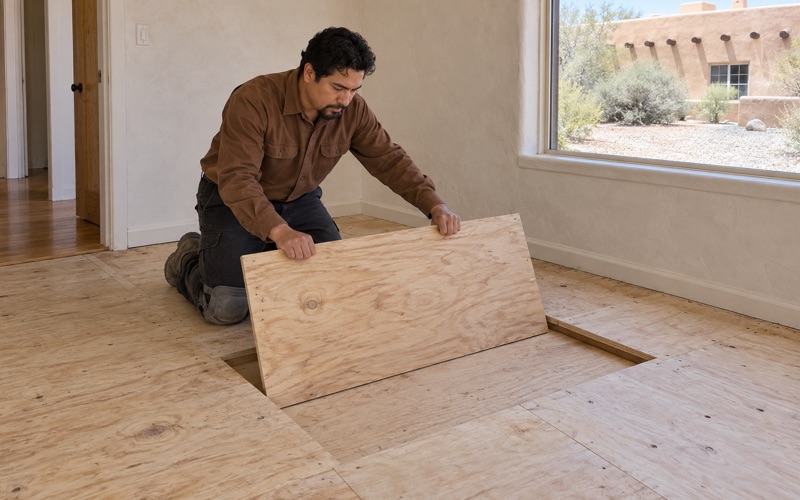
Modular sections are framed in a factory and joined on site, and the line where two sections meet is where we look first. A joint that has shifted slightly can telegraph through a new floor as a ridge or a squeak, so we check the plywood subfloor or OSB subfloor for flatness across it before any wood goes down. Where it is out of tolerance, we correct it rather than let the new floor absorb the difference.
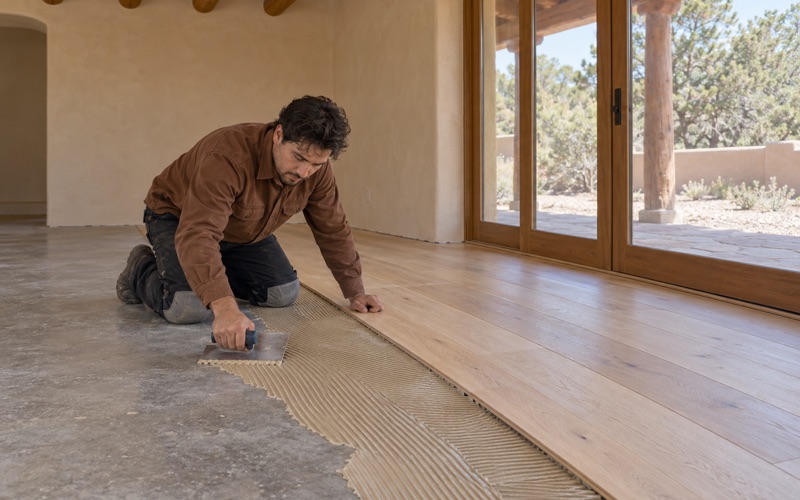
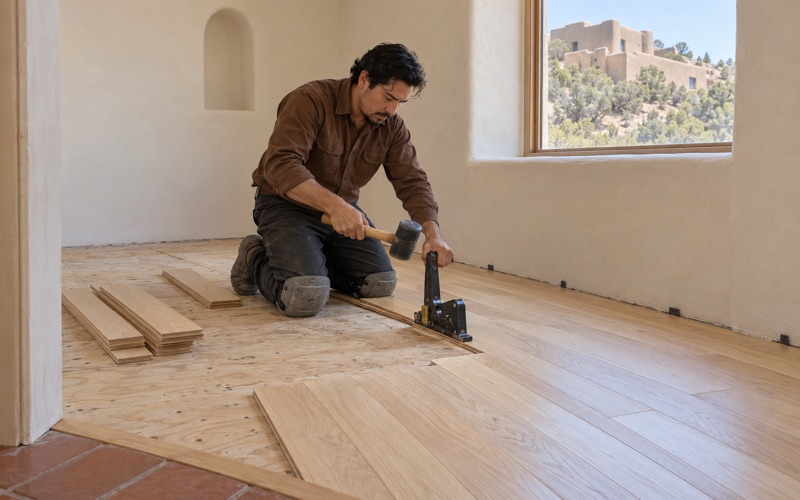
Factory subfloors can differ from site-built ones in thickness and fastening. We confirm the subfloor thickness and floor joist spacing, then choose among a nail-down installation with cleat nails, a glue-down installation or a floating installation of engineered wood based on what the structure will actually hold.
Stick-Built Homes
The stick-built homes that followed were framed on site, which usually means a more conventional subfloor but not a uniform one. Builders choose their own panel products and fastener schedules, and a newer house can still carry a subfloor that got wet during framing. We take readings with a wood moisture meter in the subfloor and in the flooring itself, and we write them into the estimate.
Either way, the aim under the NWFA installation guidelines is a floor laid when the wood and the subfloor sit close to the moisture content the house will hold through the year. In a dry climate that number is low, and wood shipped from a humid mill arrives well above it.
Acclimation Before Installation
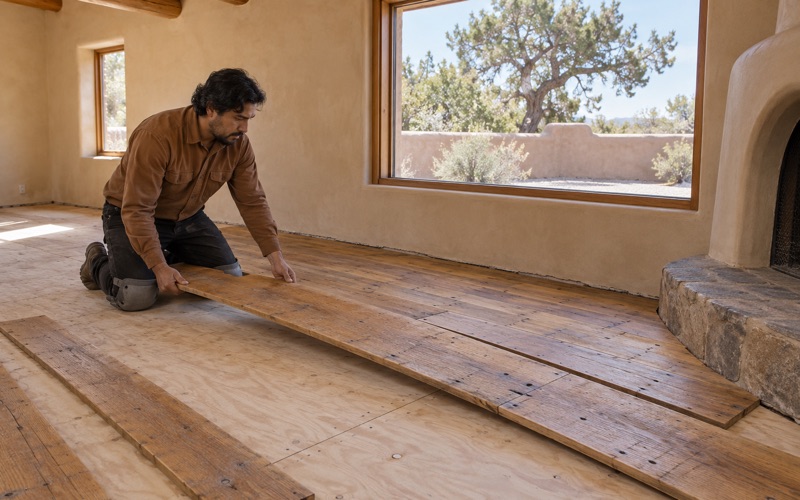
We acclimate flooring inside the house, not in a warehouse, and we do not start until the boards have moved toward the equilibrium moisture content for that home. Reclaimed wood and wide plank stock get extra time, because boards milled somewhere wetter are the ones that open up in the first winter. The readings go on paper so the owner can see why the start date is what it is.
Species and construction follow from the same readings. Engineered core construction moves less than solid hardwood as the seasons change, and wear layer thickness decides how many future sandings a board can take. Where an owner wants solid white oak, red oak, hickory or maple, we compare Janka hardness ratings against how the room is used, since a hallway with dogs asks more of a floor than a spare bedroom.
Caring for Floors Installed Since 2000
Dry Air Comes First
For weather purposes San Felipe Pueblo sits in the National Weather Service’s Santa Fe Metro Area forecast zone, NMZ218. Whatever the forecast says on a given day, the indoor question we ask about a gapped floor is the same: what is the relative humidity in this room in January? Board gaps, checking and winter squeaks usually trace to that number rather than to a bad installation, so we leave the owner with a written indoor humidity target instead of a guess.
Where a home has hydronic radiant floor heating, wood over it follows its own rules. The NWFA radiant heat guidelines cap the floor surface at 80 degrees Fahrenheit, limit temperature changes to 5 degrees a day and rule out setback thermostats. We plan the flooring and the heating routine together so the first cold snap does not undo the installation.
Refinishing in Owner-Held Homes
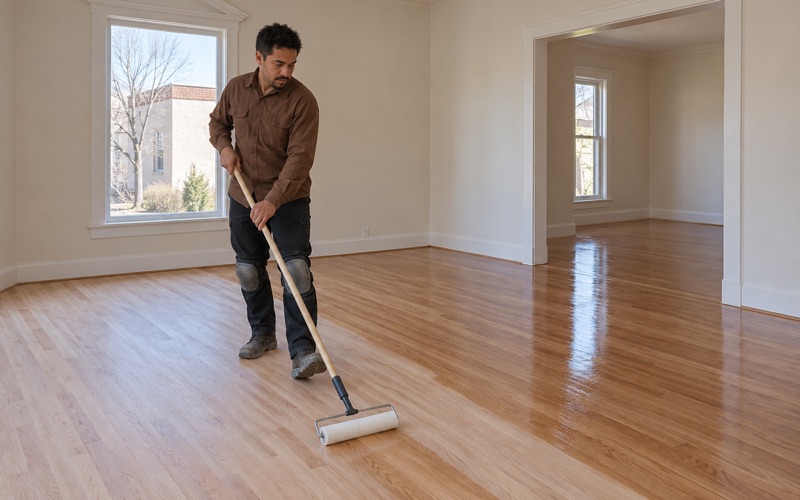
Of 233 occupied homes the census survey counts here, 226 are owner-occupied, about 97 percent. Owners plan for the long run, and the long-run question for a floor laid in the 2000s or 2010s is when to screen and recoat and when to sand. A finish that is dull but intact takes a screen and recoat, while peeling polyurethane, pet urine stains or bare wear lanes call for full refinishing with a drum sander, an edger and a proper grit sequence.
We run a dustless sanding system in occupied homes and choose finishes that meet the federal architectural coatings VOC limits under 40 CFR 59 Subpart D. Low-odor waterborne polyurethane lets a family stay in the house, and oil-modified polyurethane or a hardwax oil finish is available where the look calls for it. For the older homes in the CDP, those built before 1978, we follow lead-safe work practices before any old finish is sanded.
Color is part of the decision too. A floor finished in the 2000s can show sun fading near windows or the amber cast known as orange oak, and a fresh sanding is the moment to change it. We test stain on the actual floor before committing, because red oak and maple take color differently and a blotchy stain is far harder to fix after the fact.
Board Replacement and Water Damage
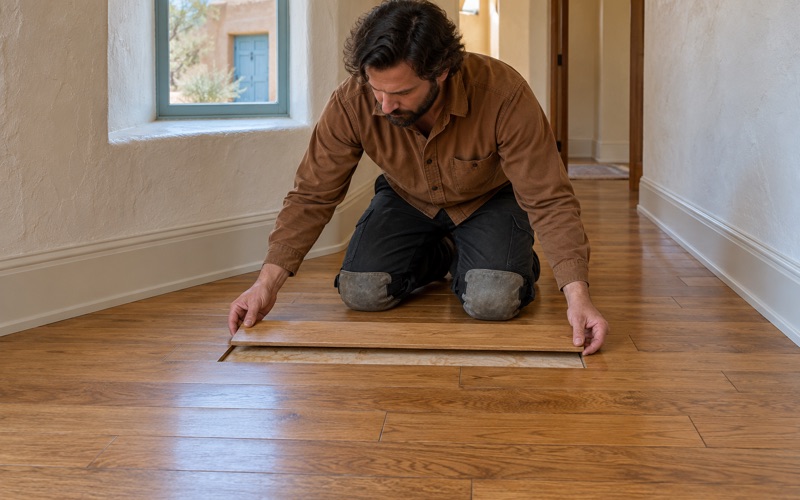
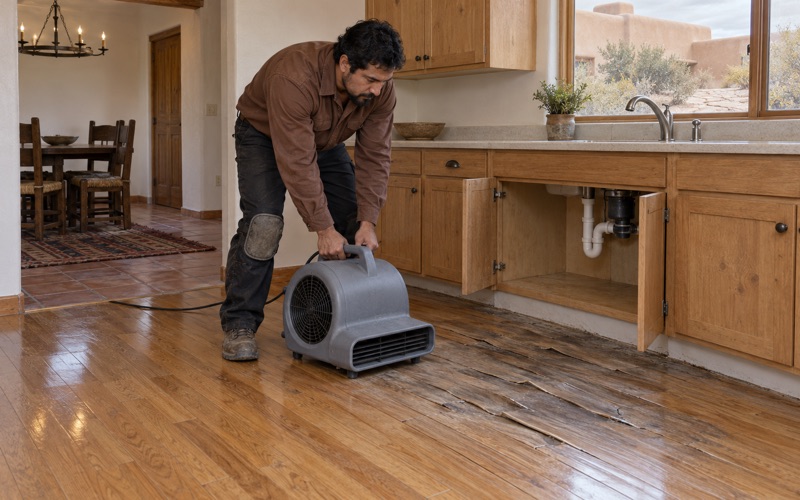
Newer floors take damage from the same sources older ones do: a dishwasher line, a water heater, a leak in a radiant heat line. We trace water to its source before replacing anything, then document the damage with photos and moisture readings an adjuster can use. Damaged boards come out and new ones are woven into the existing field so the repair does not read as a patch.
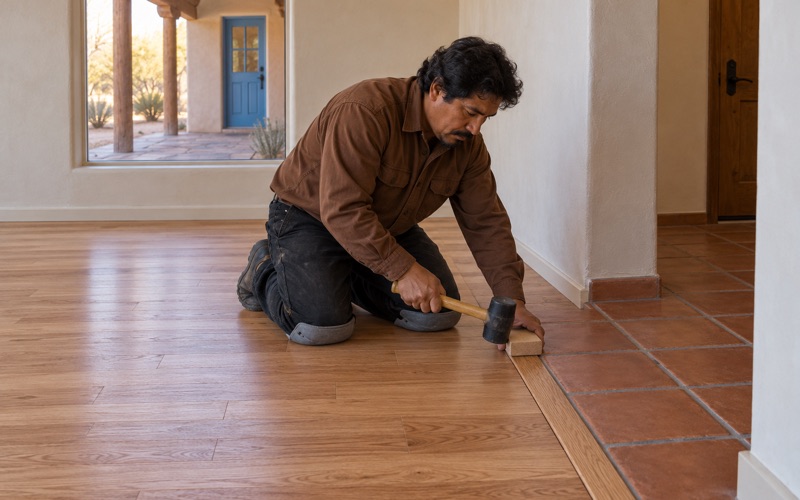
Transitions are the other common repair in newer homes. Where a wood floor meets Saltillo tile, brick or flagstone, we plan the transition strip, reducer strip or T-molding so the doorway carries no lip and no gap.
Working on Pueblo Land: The Pueblo’s Rules Come First
Start With the Pueblo’s Requirements
San Felipe Pueblo is the land of a federally recognized tribe, and work in a home there happens under the Pueblo of San Felipe’s own rules. We do not assume that arrangements used in Santa Fe or elsewhere carry over, and we do not tell owners what the Pueblo requires. Before a job is scheduled, we ask the homeowner to confirm with the Pueblo what applies to outside contractors working in their home, and we follow what they are told.
Some Black Mesa View homes were financed with HUD Section 184 mortgages. If a loan or any other agreement on a home says something about alterations, the owner knows those terms better than we do, and we plan the scope around them.
What We Bring to the Job
On any job here, we arrive with a written, itemized estimate, the moisture readings behind it and a cure schedule showing when each room can be used again. That paperwork serves the owner’s own records and anyone else who has a say in the work. It also makes comparing a repair against a full refinishing straightforward.
We keep the work contained to the rooms agreed on, protect adjoining floors and clean up at the end of each day. Furniture moves, drying times and the order of rooms are settled before the first day, so no one is surprised midweek. In a place where nearly every occupied home is lived in by the household that owns it, the way a crew conducts itself matters as much as the floor it leaves behind.
A Neighborhood Still Growing
The Pueblo’s capital plan seeks a community center in the subdivision area, a sign that the neighborhood around these homes is still taking shape. As it fills in, more of the local housing stock will be young floors on their first finish. Our job is to help those floors reach their second and third decades in good condition: measure first, settle the humidity before touching the boards, and refinish when the wear calls for it rather than on a calendar.
- 20+ Years Experience
- Written Moisture Readings
- Itemized Written Estimates