
Santa Fe Wood Flooring handles projects to replace carpet with hardwood in Santa Fe, NM, serving surrounding cities including Agua Fria, La Cienega, Eldorado at Santa Fe, Valencia and Lamy. We also take up Saltillo tile, brick and old vinyl and put down wood in their place. After 20+ years of these conversions, we know most of the work happens before the first board goes down.
What comes out decides what goes in. Carpet over a plywood subfloor is a straightforward swap. Saltillo tile or a brick floor set in mortar over a concrete slab means heavy removal, slab grinding and a moisture test before wood can go anywhere near it.
The other half of the job is the edges. A conversion that stops at a tiled kitchen, a brick entry or a flagstone sunroom needs a planned transition at each doorway, so we measure every one of them at the estimate visit.
Replacing Carpet With Hardwood
What Is Under the Carpet
In some older houses, the carpet covers an oak strip floor that can be refinished rather than replaced. In others, it sits on a plywood subfloor, an OSB subfloor or a concrete slab. We lift a corner before quoting, because the answer changes both the method and the price.
A hidden oak floor is worth finding. Even with tack strip holes around the edges and a few stained boards, it can often be repaired and refinished for less than a new floor, and it keeps the original wood in the house.
Removing Tack Strip, Pad and Staples
Carpet tack strip is nailed or glued around the edge of every room, and pad is often stapled to the subfloor every few inches. Every staple and nail has to come out and every glue residue has to be scraped flat, or they telegraph through the new boards. We also check the subfloor for soft spots hidden under the pad.
Pet accidents that soaked through the carpet often reach the subfloor as well. We look for staining and odor in the panels once the pad is up, and seal or replace affected sections so the smell does not come back through the new floor.
Choosing the Right Floor for the Substrate
Over a sound wood subfloor, solid hardwood nailed down is the traditional choice. Over a slab, engineered hardwood glued down or floating is usually the better fit. We recommend by substrate, height and use rather than pushing one product for every room.
Where carpet ran through several connected rooms, the new wood usually runs through them all in one direction, so we plan the layout across the whole area rather than room by room.
Replacing Saltillo Tile or Brick With Wood
Removing Tile and the Mortar Bed
Saltillo tile is usually set in a thick bed of mortar, and brick floors are often laid the same way. Removing them is dusty, heavy work. We seal off the rooms, remove the tile and mortar down to the slab, and haul away the debris.
What is left is rarely flat enough for wood. The slab usually needs grinding and patching before a glue-down or floating floor can go down over it.
Testing the Slab for Moisture
A slab that sat under tile for years may hold more moisture than wood will tolerate. We test it with a calcium chloride moisture test or an in-situ relative humidity test and write the result on the estimate. That result decides whether we need a moisture-rated adhesive, a vapor retarder or more drying time.
The test runs after the tile is up and the slab has been exposed for a while, not through the old tile, since a reading taken under a covered surface does not describe the slab the wood will actually sit on.
Radiant Heat Under Old Tile
Some homes with Saltillo or brick floors also have hydronic radiant heat in the slab. Wood over radiant heat is possible, but it must follow the NWFA radiant heat guidelines: a floor surface no hotter than 80 degrees Fahrenheit, changes of no more than 5 degrees a day, and no setback thermostat. We plan the product and the start-up schedule around those limits.
Heights, Transitions and Doorways
Planning the Finished Floor Height
A new wood floor can finish higher or lower than the surface it replaced, and higher or lower than the rooms that keep their tile. Door bottoms, appliance clearances and cabinet toe kicks all depend on that height. We measure it before ordering, not after the doors stop closing.
When the height change is large, we can adjust with a thinner product, a leveling layer or by trimming doors and toe kicks. Each option is listed on the estimate, so the choice is yours before the old floor comes up.
Where Wood Meets Tile, Brick or Flagstone
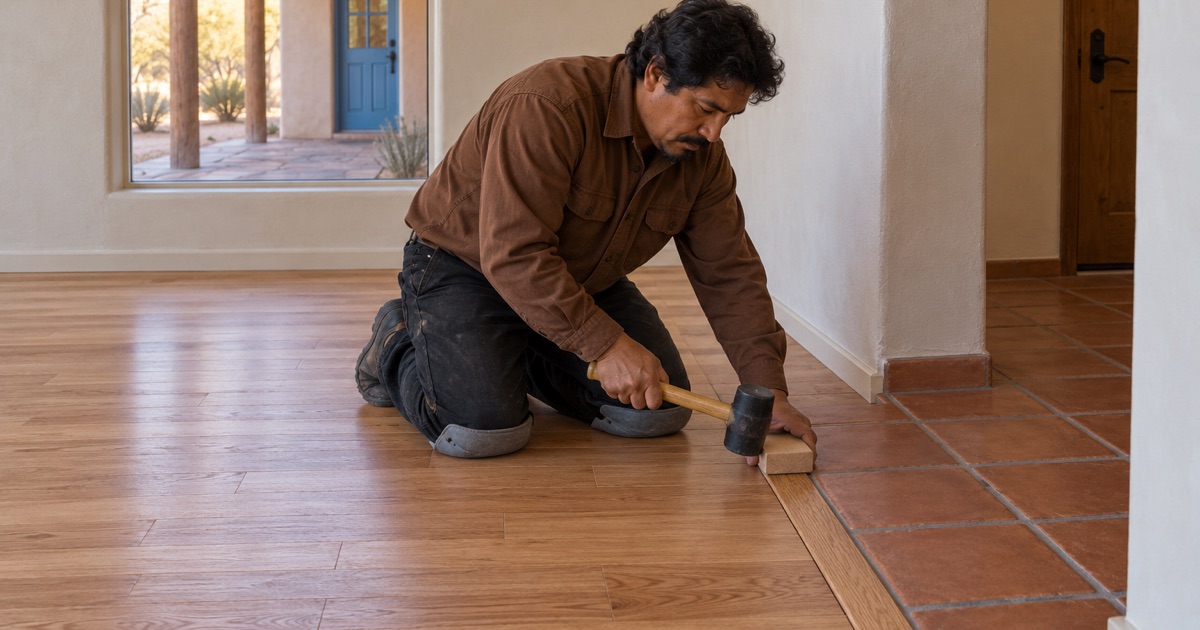
Where a new wood floor meets Saltillo tile, brick or flagstone, we plan the transition from the measured height difference: flush where the heights allow, a reducer strip where the wood is higher, or a T-molding where two floors meet at the same level. Each one leaves the expansion gap the wood needs to move with the seasons.
We match the trim species and stain to the new floor, and set it so the edge of the tile is protected rather than left exposed to chipping. A good transition should look like it was always meant to be there.
Condominium Rules When Replacing Carpet
In a condominium, replacing carpet with a hard floor can affect noise in the unit below. Under the New Mexico Condominium Act, the declaration governs alterations beyond a unit’s own interior, and many associations have their own hard-floor and underlayment rules. We read those with you before ordering, so the floor is approved before it is installed.
- 20+ Years Experience
- Written Moisture Readings
- Itemized Written Estimates