Santa Fe Wood Flooring brings more than 20 years of wood flooring work to homes in Ohkay Owingeh, from sanding out a tired living room floor to replacing a few boards that split over a dry winter. We start each job the same way, with a moisture meter and a notebook, because the readings taken in the wood and the subfloor decide what comes next.
Most of the floors we are asked about here belong to detached houses built in the late twentieth century, and most of those houses are lived in by the people who own them. That shapes the work. An owner who plans to stay usually wants a floor that holds up for years rather than a quick cosmetic pass, so we plan for durability and for the dry indoor air that pulls moisture out of wood every heating season.
This page covers what changes about floor work in this community: the age of its houses, the problems their floors tend to show, and the line between our work and the Pueblo’s own authority over its land. Where a question belongs to Ohkay Owingeh rather than to a flooring contractor, we say so plainly.
Owe’neh Bupingeh, the Historic Village Core
Ohkay Owingeh is a Tewa pueblo in Rio Arriba County, known by its Spanish name as San Juan de los Caballeros and informally as San Juan Pueblo, a name that carried official status from 1598 to 2005. In November 2005 the people returned to their original name. The Census Bureau treats the community as a census-designated place, and Ohkay Owingeh is also the federally recognized tribe whose people live there.
What the Preservation Plan Restores
At the center of the community sits Owe’neh Bupingeh, the historic village core. Its homes are interconnected handmade adobe dwellings coated in mud plaster, arranged around four plazas that were once surrounded by several hundred homes. By 2005 most of them had been abandoned because of deterioration.
The tribe answered with the Owe’neh Bupingeh Preservation Plan, described as the first comprehensive preservation plan developed by a Pueblo tribe. The plan rehabilitates the ancestral homes as affordable housing, using local, indigenous materials and adding energy conservation features. The first two phases, completed in March 2012, rehabilitated 20 homes along with infrastructure for the full place.
The work has drawn national notice. The plan received a 2013 national planning award from the American Planning Association, and HUD lists it for the 2013 HUD Secretary’s Opportunity and Empowerment Award. Funding has reached about $8.97 million for planning, design, infrastructure and construction, with roughly $4 million more needed to complete the final phase.
Where Our Work Fits
We describe the project because it is the most significant housing story in Ohkay Owingeh, not because it is ours. The rehabilitation belongs to the tribe, with the Ohkay Owingeh Housing Authority as the project’s owner, and we play no part in it. Our work is on the detached houses built in later decades, which make up the larger share of the community’s homes.
Looking for wood-flooring closer to San Felipe Pueblo? See Wood-Flooring Services in San Felipe Pueblo.
Houses Built in the 1970s and 1980s
Outside the plazas, the housing is much newer. Of an estimated 354 housing units, 126 were built in the 1970s and 95 in the 1980s, which puts about 35.6 percent of the stock in the 1970s alone and about 26.8 percent in the decade after. The preservation record itself notes that HUD-created subdivisions of the 1970s contributed to the deterioration of life-ways, language and centuries-old construction methods.
Owners, Not Turnovers
Tenure shapes the job as much as age does. About 73.9 percent of occupied homes are owner-occupied, and most of those owners live in detached houses. That is a different conversation from a rental turnover, because the person paying for the floor is the person who will walk on it for the next decade.
It also changes what we recommend. An owner who intends to stay can reasonably invest in a full sanding and a durable finish now, where a landlord between tenants might choose a screen and recoat to buy a few more years.
What We Check First in a House This Age
A wood floor in a house of this age may have been through several rounds of wear, and sometimes a layer of carpet or a floating floor laid over the top. When we pull back carpet or lift a worn floating floor, we look at what is underneath before recommending anything, because that answer decides whether refinishing is possible at all.
Houses finished before 1978 fall inside the era when lead-based paint was still used in homes. Before any old finish is sanded in pre-1978 housing, we set up lead-safe work practices under the EPA Renovation, Repair and Painting rule, containing the dust and cleaning to a standard rather than assuming the old coatings are clean.
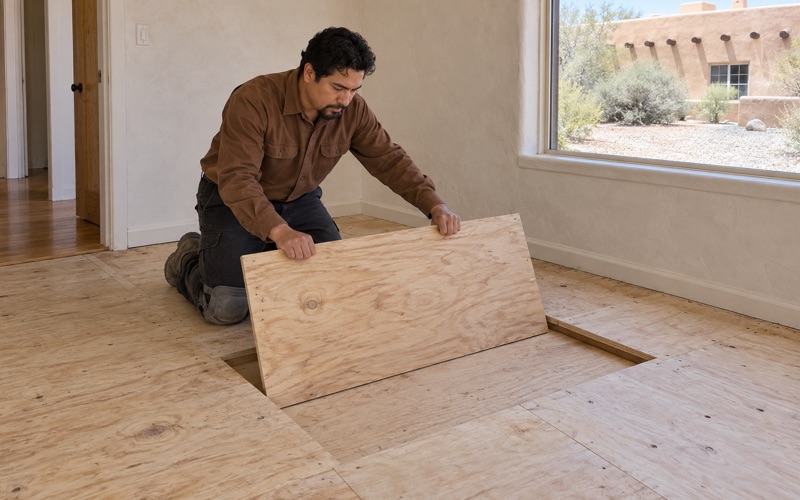
Houses from either decade can also carry older heating fixtures. Where a floor furnace or wall heater has been removed, it can leave an opening in the floor, and we patch it with boards woven into the existing floor so the repair does not read as a square patch.
Dry Air and Wood Movement
The National Weather Service places Ohkay Owingeh in its Espanola Valley forecast zone, and indoor air in a heated northern New Mexico house tends to run dry through the winter. Board gaps, checking and winter squeaks are usually a humidity question before they are a carpentry one.
We diagnose that movement by measuring relative humidity in the room and the moisture content of the boards, then writing down an indoor humidity target for the house. A whole-house humidifier or a steadier heating pattern can close gaps that no amount of filler would hold.
Humidity work also protects any refinishing we do. A floor sanded and coated at one moisture level and then dried hard over the next winter can still open its seams, so we would rather settle the indoor target before the finish goes on.
Refinishing and Repair Choices for Older Wood Floors
Screen and Recoat or Full Sanding
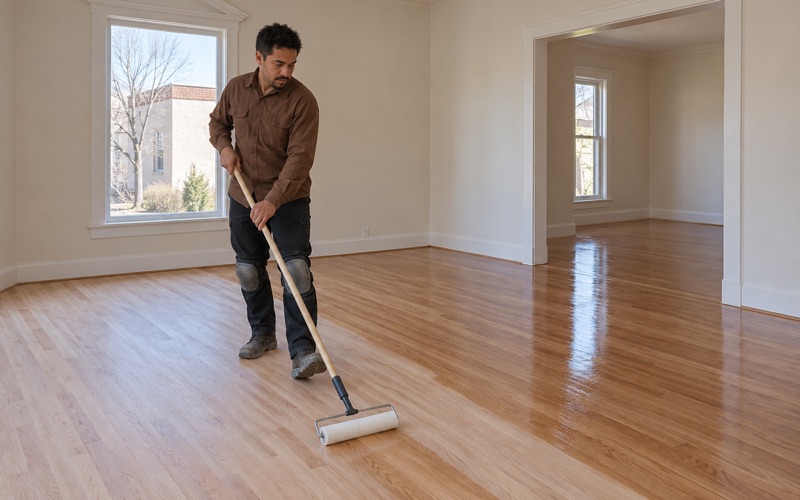
Not every tired floor needs to go back to bare wood. If the finish is dull but intact and the wood is sound, a screen and recoat abrades the top coat and adds fresh polyurethane without cutting into the wood itself. We test adhesion first, since a floor that has been waxed or cleaned with an oil soap can reject a new coat and peel.
Full refinishing makes sense when the finish is worn through, stained or peeling. We work through a grit sequence with a drum sander, edger and orbital sander, using a dustless sanding system to keep an occupied house livable, and we remove only as much wood as the floor needs so solid hardwood keeps its remaining life.
Color, Fading and Stain
If an older red oak floor sits under an oil-modified finish, it may have turned orange, and sun fading can leave a clear outline where a rug once sat. Sanding removes both and opens a real conversation about color. Waterborne polyurethane stays clearer over time, while a hardwax oil finish gives a softer look that is easy to spot-repair.
Blotchy stain is the other common complaint, especially on maple and pine. We test stain on a sanded patch in the room’s own light before committing, and we choose finishes that meet the federal architectural coatings VOC limits, with low-odor waterborne options for families who stay home during the work.
Board Replacement and Water Damage
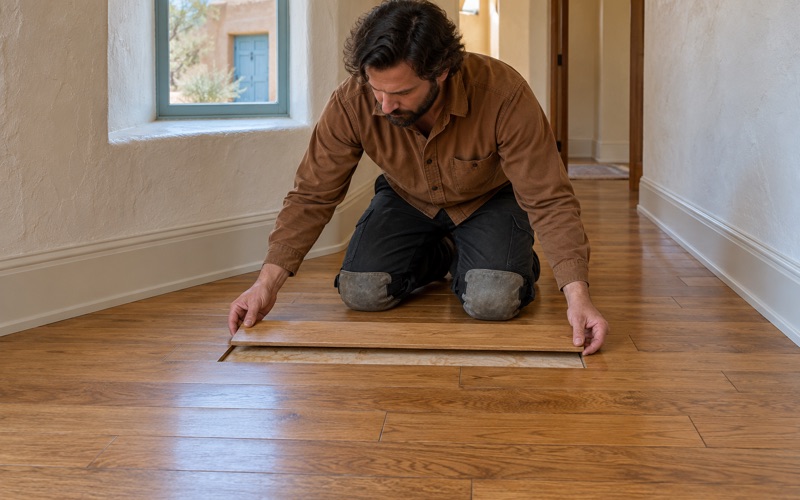
Pet urine stains, cupped boards beside a leaking appliance and split boards near an exterior door usually call for board replacement rather than sanding. We weave new boards into the existing pattern, matching species and width, so the repair blends once the floor is refinished.
Squeaks that persist after the humidity is corrected usually point to loose boards or fasteners working against the subfloor below. We can often quiet those from the top with a cleat nail or a trim screw set below the surface, then fill and touch up the spot so the fix is hard to find.
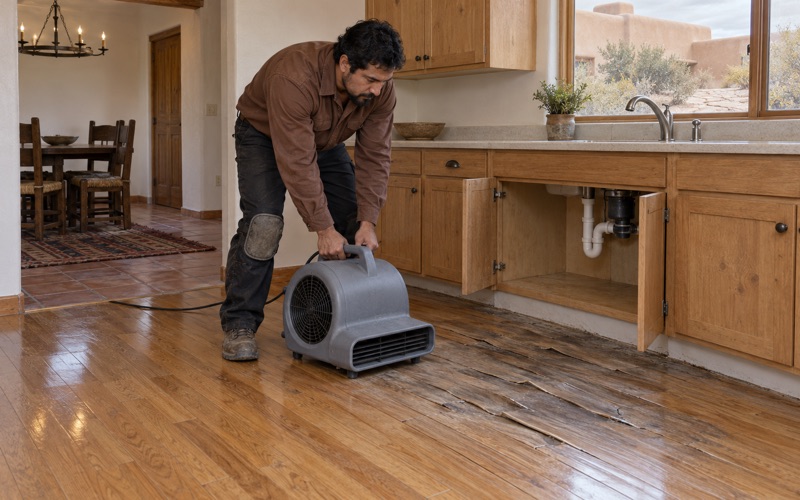
When water is involved, we trace it to its source before touching the floor, including a leak in a radiant heat line. Photos and moisture readings go into a written record an insurance adjuster can use, and we do not install or refinish over wood or a subfloor that is still wet.
If a house has hydronic radiant floor heating, we plan any wood over it to the NWFA radiant heat guidelines, which cap the floor surface at 80 degrees Fahrenheit and limit temperature changes to 5 degrees a day. Those guidelines rule out a setback thermostat, so the heat has to run steady rather than dropping overnight.
Working Within the Pueblo’s Own Rules
Ohkay Owingeh is one of 19 federally recognized Pueblo tribes in New Mexico, and rules on Pueblo land come from the Pueblo itself. We do not offer answers about what a homeowner may need from the tribe before work begins, and we do not treat state or county practice as if it settled that question.
Before a job starts, we ask the homeowner to confirm with Ohkay Owingeh what applies to their home, and we plan the schedule around what they are told. That keeps the decision where it belongs and keeps a floor project from running ahead of the community’s own process.
Written Readings and an Itemized Estimate
Moisture is measured in the wood, the subfloor and any concrete, and the readings are written down before any material is ordered. The estimate that follows is itemized, so an owner can see what the sanding, repairs, finish and transitions each cost.
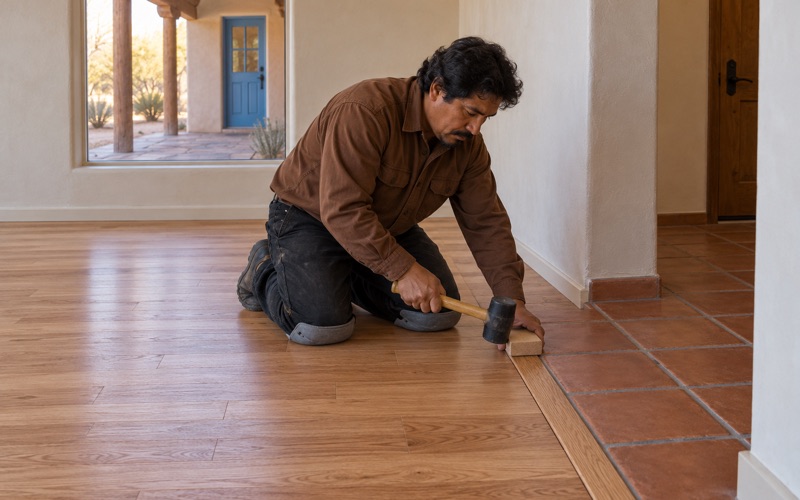
Where a wood floor meets Saltillo tile, brick or flagstone at a doorway, we plan the transition, whether a reducer strip, a T-molding or a flush detail, so the floor ends cleanly instead of leaving a lip or a gap. Wood still needs its expansion gap where it stops against tile or stone, so the detail has to hide that space rather than close it.
Choosing Material for a Replacement Floor
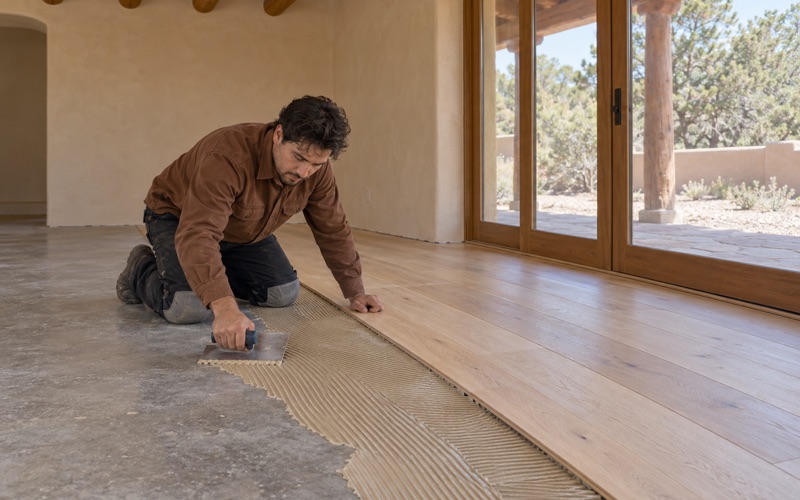
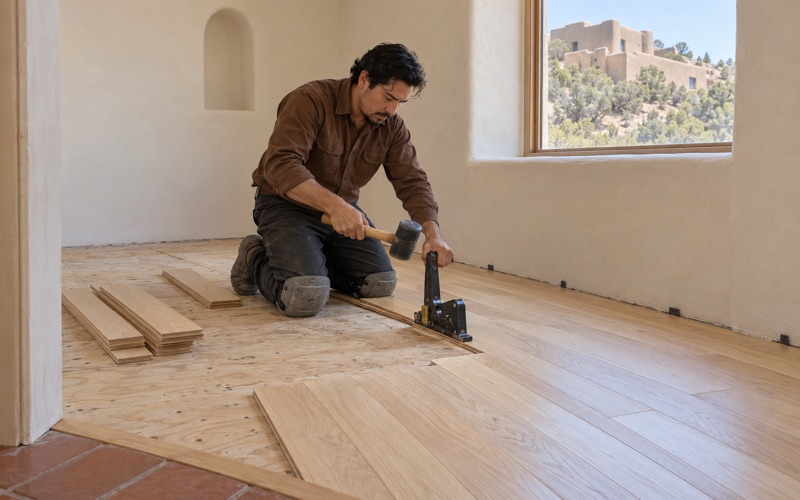
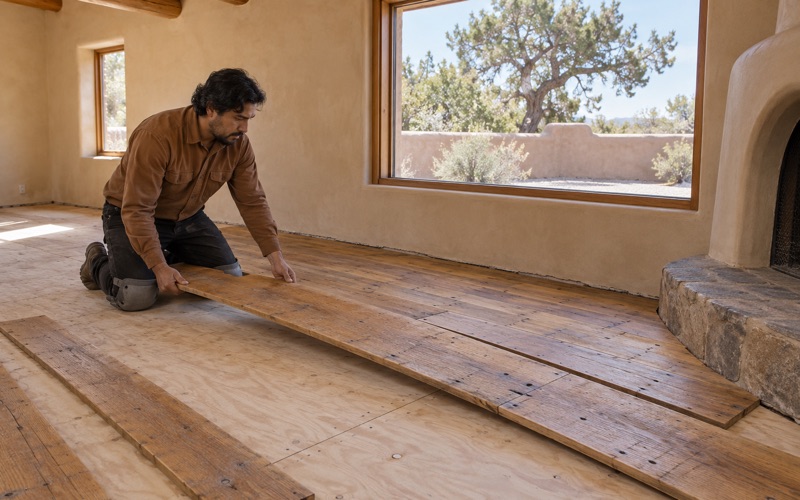
Owners replacing a floor outright have more options than when these houses were built. Engineered wood with a generous wear layer handles dry-season movement well, while solid white oak, hickory or wide plank pine give a more traditional look, and reclaimed wood suits owners who want visible age. Whatever the species, we acclimate the boards inside the house before they go down, so wood milled somewhere wetter does not open up in its first winter.
Floor care in Ohkay Owingeh comes down to respecting two things at once: how wood responds to dry air, and the community’s authority over its own land. We handle the first with meters and written numbers, and we leave the second to the Pueblo.
- 20+ Years Experience
- Written Moisture Readings
- Itemized Written Estimates