Santa Fe Wood Flooring has spent more than 20 years on wood flooring in Madrid and the rest of the county, and the work here leans toward old floors: sanding, repair and board replacement in houses that have stood for close to a century or longer. We look at what is actually down, what is holding it up and how much wood is left before we suggest anything. Then the plan goes into writing, room by room.
Most calls from this town start with a floor that has been walked on for generations. Some boards have worn thin, some have split or worked loose, and some were patched long ago with whatever wood was at hand. Our aim is to keep as much of the original floor as the boards can give, replace only what has failed and finish the room so the repairs sit quietly inside the old layout.
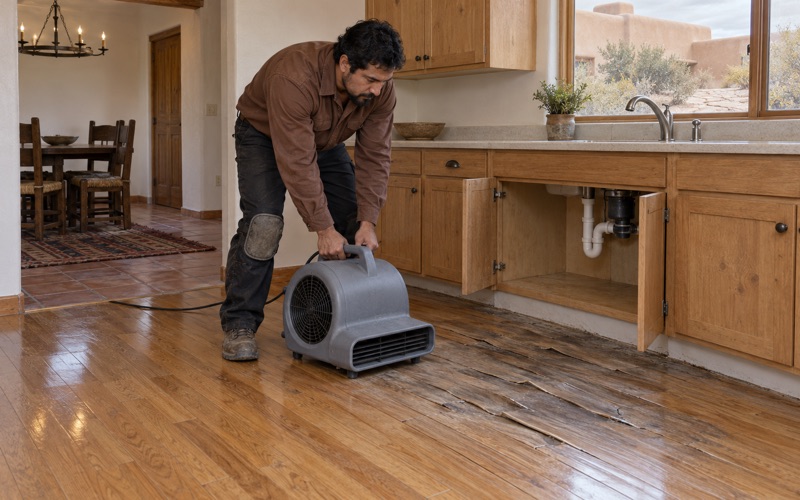
Before any material is ordered, we take moisture readings in the wood and the subfloor and record them on paper. Estimates are itemized, so you can see what each part of the job costs and why it is there. What follows is how we approach the floors in these houses.
A Company Coal Town and Its Oak Floors
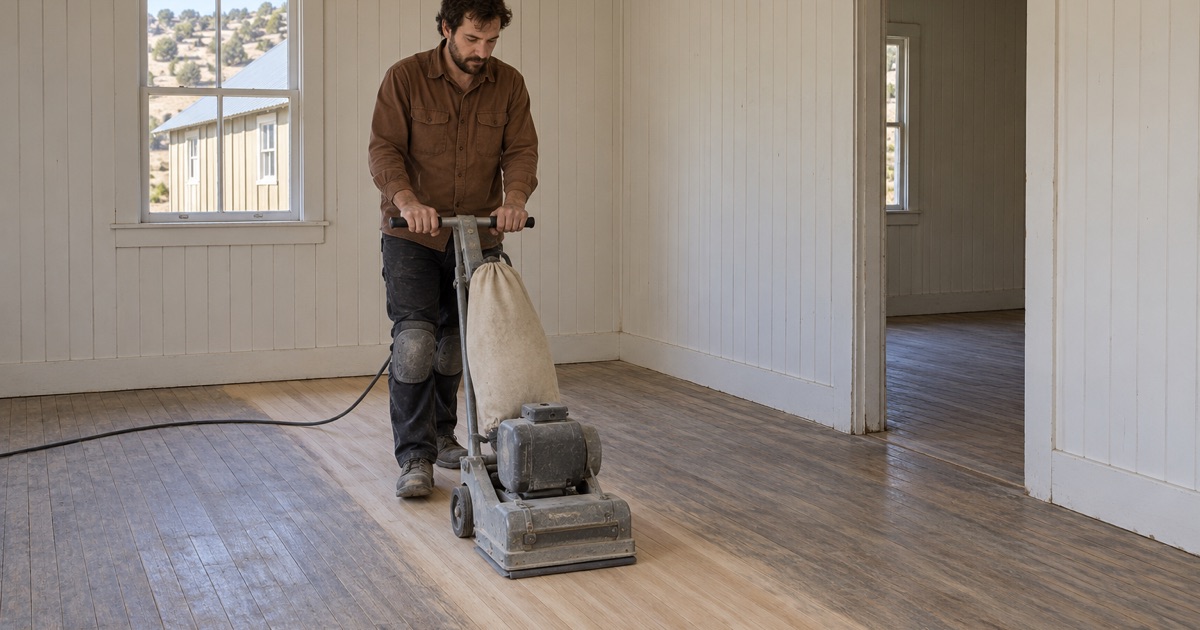
Madrid is a census-designated place in Santa Fe County, and it grew up as a company coal town, where the company owned the houses and rented them to the miners who worked there. The Madrid Historic District covers about 200 acres. It was placed on the New Mexico State Register of Cultural Properties in 1974 and entered on the National Register of Historic Places on November 9, 1977.
The mines closed in 1954. Around 1975 the lots and houses still standing were offered for sale piecemeal, and that sale is how the old company stock passed into private hands one property at a time. Floors in the older houses were first laid while the company still owned them.
What the nomination says about the floors
The National Register nomination is unusually specific about interiors. It describes the company buildings as frame construction with board-and-batten siding, finished inside with tongue-and-groove paneling and oak floors. For a floor contractor that is a useful starting point, because it tells us which species we are most likely to find under old carpet or layers of darkened finish.
It is still only a starting point. A house lived in for a century may have had rooms added, boards swapped out or a second floor laid over the first, so we confirm the species and the milling at a threshold or a register before planning anything. What we find there decides the stain test, the patch stock and how hard the floor can be sanded.
About half the stock predates 1940
The American Community Survey estimates about 290 housing units in Madrid, and roughly 154 of them were built in 1939 or earlier. For a place this small the margins are very wide, plus or minus 174 on that one figure, so we read it as a shape rather than a count. The shape is still plain: something like half the homes here are older than 1940, with a separate group dated to the 1980s.
That age matters for more than the wood. Any house built before 1978 calls for lead-safe work practices before an old finish is sanded, and that includes the painted trim and baseboards a floor job disturbs. In those rooms we set up containment and run a dustless sanding system on the drum sander and edger.
Looking for wood-flooring closer to Cochiti? See Cochiti Wood-Flooring.
Houses on Piers and What That Means for a Floor
After 1919, new one-story houses went up in Madrid, and the nomination describes them plainly: frame construction on pier foundations, sided with vertical board and batten, with plaster walls inside. That statement covers those later company houses, not every building in town. The district also holds older frame houses, bungalows and some adobe and stone buildings, so we check what each one stands on rather than assuming. Where we can reach under a pier-built floor, we look at the joists and supports before we plan any sanding.
Settling and a floor that is no longer flat
The nomination credits the dry climate for preserving these structures, and it also records considerable settling of the buildings. On a floor, settling shows up as a slope across a room, a hump over a support or gaps that open along one wall while the other side stays tight. A drum sander follows those contours only so far, and forcing a settled floor flat by sanding can cut through the wear surface on the high spots.
When a room has moved, we tell you which part is foundation work and which part is floor work, and we price only the floor. Sanding can even out small differences in height between neighboring boards, but it cannot level a room that has dropped on its piers. Where the framing needs attention, that happens before we sand, not after.
Moisture from below
A frame floor raised on piers has open air beneath it rather than earth or concrete pressed against it. Seasonal swings in humidity reach the underside of the boards directly, and in the driest months the oak can lose moisture from both faces. The usual results are board gaps, checking and splitting on the surface and winter squeaks that return year after year.
We treat those symptoms as a humidity question before a carpentry one. A wood moisture meter tells us the moisture content of the boards, we compare it to the equilibrium moisture content the house actually holds, and you get a written indoor relative humidity target. If a humidifier would close the gaps, we recommend one, and if the house cannot hold the target, we tell you before any boards are replaced.
Sanding, Repair and Board Replacement
Old oak rewards a slow approach. The goal is to keep sound wood in place, fix what has failed and take off no more material than the boards can spare, so the floor has sandings left for the next owner. We would rather leave a few character marks in a century-old floor than grind away the last of its wear surface to erase them.
Reading the boards before sanding
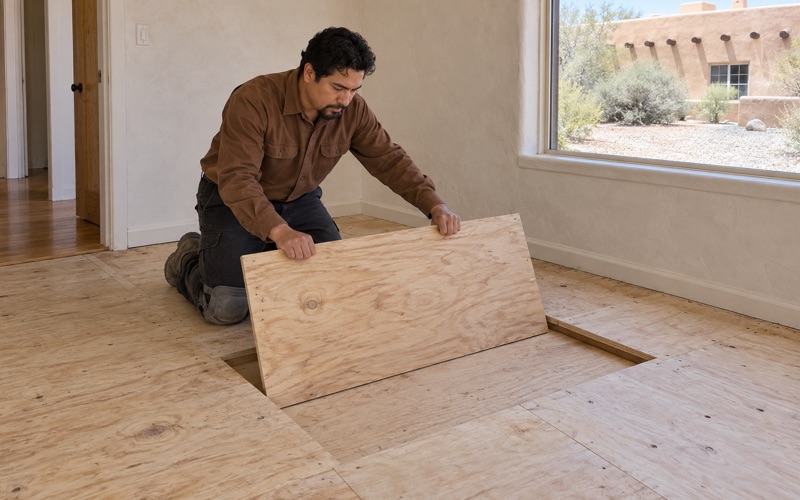
Century-old oak may have been sanded several times already. We check how much wood remains above the tongue, usually at a floor register or a threshold where a board edge shows. A floor with a thin margin gets a lighter sanding with a careful grit sequence, or a screen and recoat if the finish is still sound, rather than a full cut that exposes tongues and nail heads.
Cupping, crowning and loose boards each get traced to a cause before any sanding starts. A refinish laid over an unsolved problem brings that problem back, usually within a season or two. A cupped board sanded flat while it is still damp underneath will crown once it dries.
Board replacement and weave-in repairs
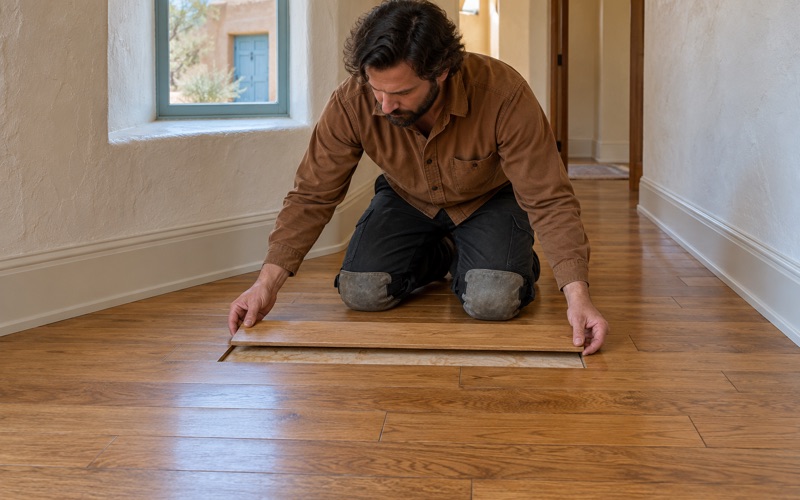
Where oak boards have split, been damaged by a leak or been cut for pipes and heaters, we take them out back to sound wood and weave new boards into the existing floor. Staggering the joints keeps the patch inside the pattern instead of reading as a square filler. The same weave-in repair closes old floor furnace openings and the holes a wall heater leaves behind.
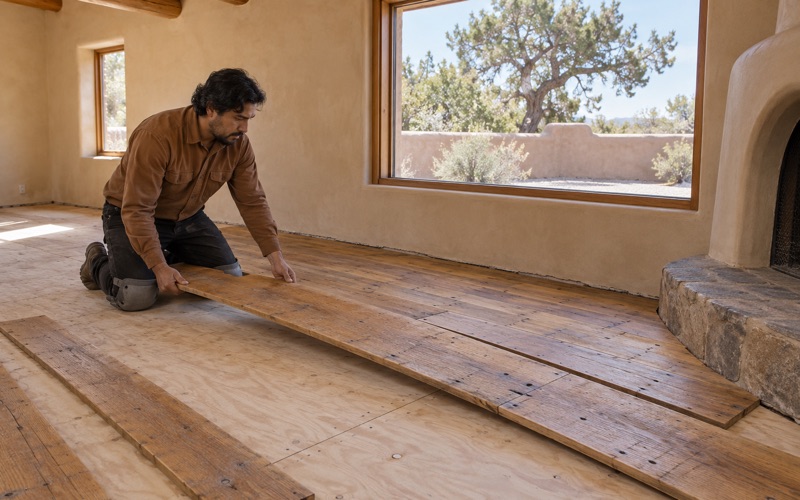
Matching old oak takes more than the species name. We look at board width, grain and the color the wood has taken on over the decades, and we acclimate the replacement stock inside the house until its moisture readings match the floor around it. Reclaimed oak is often the closest match, and it needs that acclimation as much as new wood does, because boards milled somewhere wetter shrink once they reach this dry air.
Finishes for an old floor
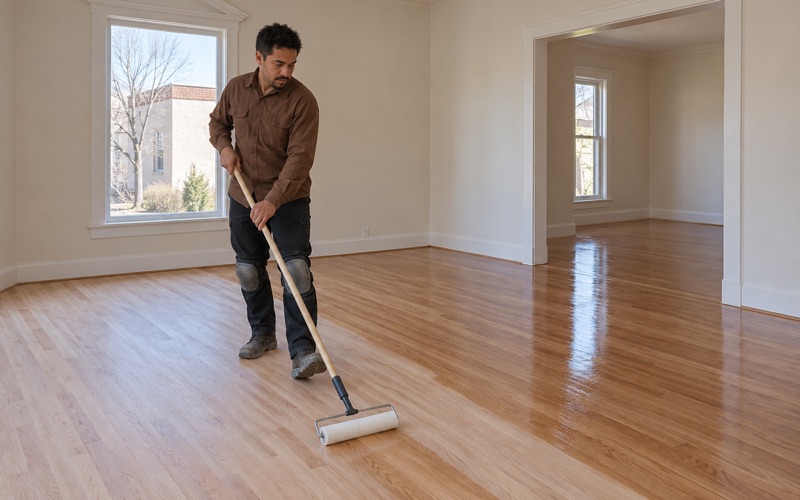
Oak that has aged under oil-based finishes often turns orange, and a full sanding resets the tone. We test stain on the floor itself, in a closet or a corner, so a blotchy result shows up on a few inches rather than across the room. Our finishes meet the federal architectural coatings VOC limits in 40 CFR 59 Subpart D, and waterborne polyurethane is the low-odor choice for a household staying home during the work.
Planning Floor Work on a Madrid House
Most jobs here are one house at a time, often one or two rooms. The ACS counts about 228 occupied units in Madrid, and its estimates put more of them in renter hands than owner hands, with every renter household in a detached house. The margins are wide enough that we treat the split loosely, but it shapes how we schedule and document the work.
Owners, landlords and rentals
Owners who live in the house usually want the job staged so part of the home stays usable, and we set the room order around that. A landlord gets an itemized estimate that separates ordinary wear from damage such as pet urine stains or peeling polyurethane, which is the kind of paper that supports deposit deductions under New Mexico’s 30-day rule. For a short-term rental, we book the work between guests and hand over a written cure schedule with the date the unit can take bookings again.
Transitions, newer houses and heat
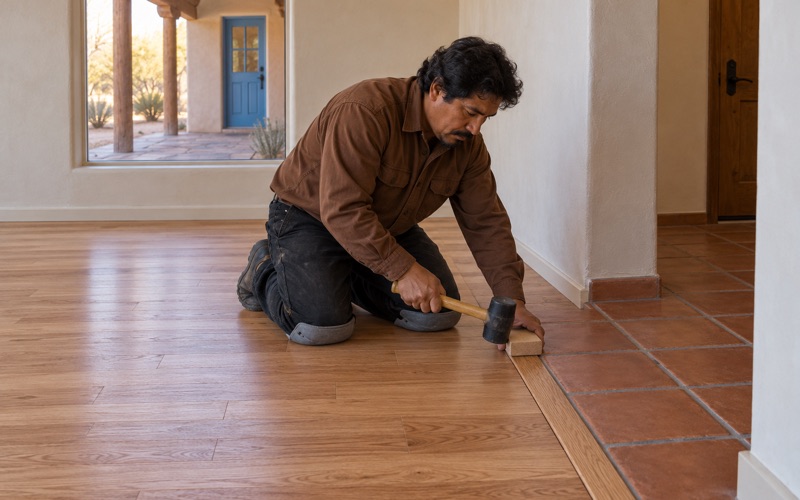
Where a wood floor meets Saltillo tile, brick or flagstone, we plan the transition before the wood goes down. A flush joint, a reducer strip or a T-molding is chosen so there is no lip at the doorway and no gap to collect grit. If water damage is part of the problem, we trace it to its source and document it with photos and moisture readings an adjuster can use.
The houses from the 1980s are a different job from the company stock. If one has hydronic radiant floor heating, we plan wood over it to the NWFA radiant heat guidelines: the floor surface stays at or below 80 degrees Fahrenheit and temperature changes are held to 5 degrees a day. Those guidelines rule out a setback thermostat, because its nightly drops break that daily limit, so we set the heat to run steady before the new floor goes in.
Timing and a first visit
Madrid sits in the National Weather Service Santa Fe Metro Area forecast zone, and indoor humidity moves with the seasons. We time acclimation and finishing by the readings in your house rather than by the calendar. The first step is a visit: we measure, look underneath where we can reach and give you a written plan for the floor.
- 20+ Years Experience
- Written Moisture Readings
- Itemized Written Estimates