Santa Fe Wood Flooring brings more than 20 years of work to wood flooring in Los Alamos, and the jobs we see here split into two rough groups. One is the older house whose floor has been sanded, patched and lived on for decades and now needs a careful refinishing. The other is the newer or remodeled house where the question is which floor to install and how to keep it stable in very dry air.
Both groups get the same first step from us. We read the moisture content of the wood, the subfloor and any concrete before anything is ordered, and we write those readings down so you keep a copy. Gaps, checking and winter squeaks are treated as a humidity question before they are treated as a sanding question, and you leave the estimate with a written indoor humidity target instead of a guess.
The sections below explain what changes about floor work in this particular town: the age of the houses, the way attached and condo units change the plan, and how wildfire season shapes when and how we schedule. None of it replaces a visit, but it tells you what we will be looking for when we walk in.
Wood Floors in a Postwar Townsite
Los Alamos sits on four mesas of the Pajarito Plateau and is the county seat of Los Alamos County, a single incorporated city-county government. The town is recognized as one of the places where the atomic bomb was developed during World War II. The county’s Community Wildfire Protection Plan, updated in 2022, says that new residents live in existing housing that was mostly constructed from 1946 through the 1970s.
The census backs that description. Of 6,190 housing units in the town, none are counted as built before 1940, while 941 date from the 1940s and 1,189 from the 1950s, which together make up 34.4 percent of the stock. Taken more broadly, 56.7 percent of units were built before 1980.
Two Kinds of House, Two Kinds of Job
That leaves a town with a large block of postwar houses and a smaller, newer layer on top of it. About 20.4 percent of units were built in 2000 or later, and many older houses have been remodeled since they were first occupied. We plan differently for each group, because an old floor that has been sanded several times and a new floor going onto a fresh subfloor raise very different questions.
In an older house, the first question is how much wood is left to sand and what is underneath the current finish. In a newer or remodeled house, the questions are species, construction and installation method, and whether any radiant heat is in the floor. We never assume what a floor is made of from the age of the house alone; we check it.
Choosing Floors for the Newer Houses
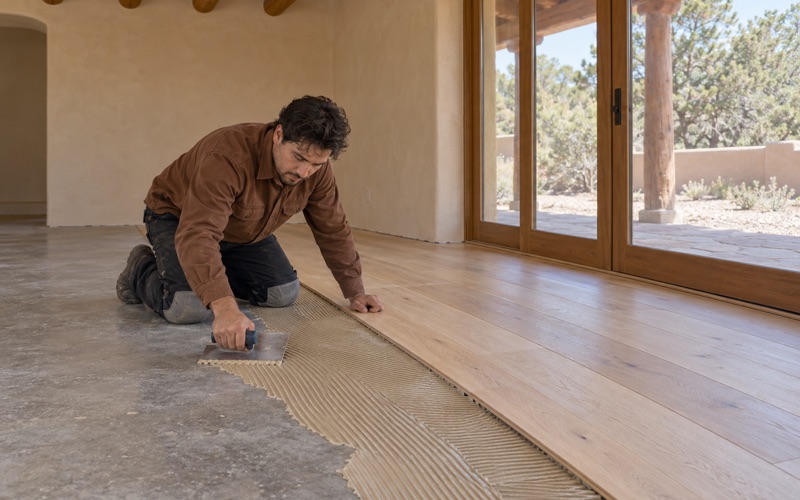
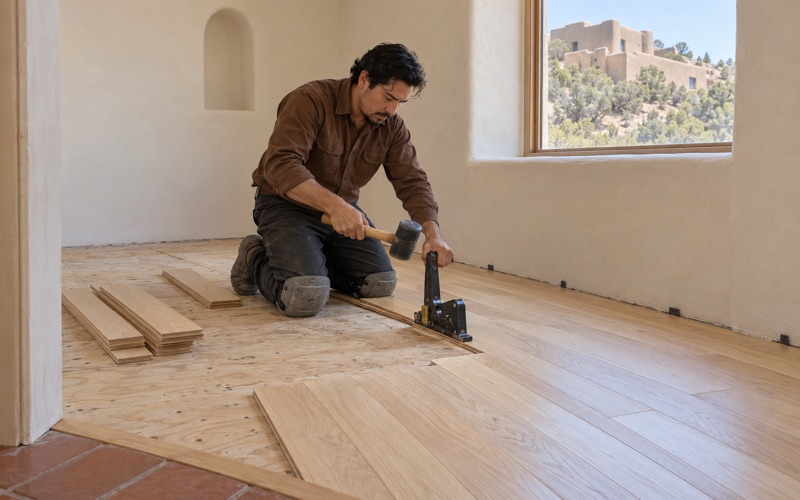
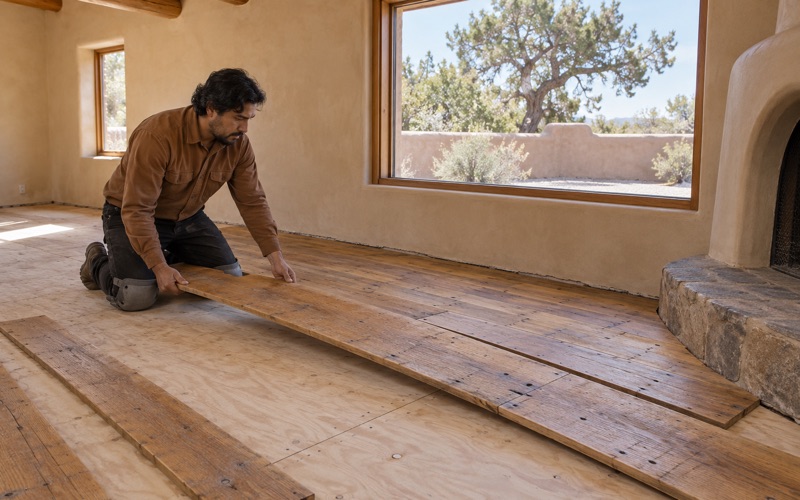
For a new floor, engineered core construction tends to move less than solid hardwood in dry air, and a thicker wear layer leaves room for future refinishing. Solid white oak, hickory or maple still perform well when the wood is acclimated to the house and indoor humidity is held steady. Reclaimed and wide plank wood gets extra acclimation time, since boards milled somewhere wetter can open up badly during their first winter here.
Where a remodel added hydronic radiant floor heating, we plan the wood to the NWFA radiant heat guidelines. Those guidelines cap the floor surface at 80 degrees Fahrenheit, limit temperature changes to 5 degrees a day, and rule out a setback thermostat under a wood floor, so the system needs to run steadily rather than cycling down at night.
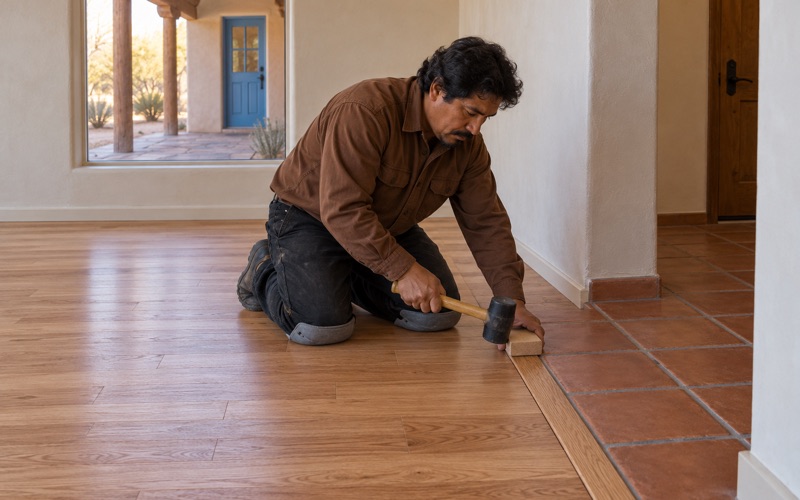
Remodels also tend to leave new wood meeting Saltillo tile, brick or flagstone at a doorway. We plan those transitions before installation, matching heights where we can or choosing a reducer strip or T-molding where we cannot, so the finished floor has no lip to catch a toe and no gap to collect grit. Planning the transition early also tells us whether one room needs its subfloor built up before the new boards go down.
Looking for wood-flooring closer to Santo Domingo Pueblo? See Wood-Flooring Services in Santo Domingo Pueblo.
Refinishing 1940s and 1950s Floors
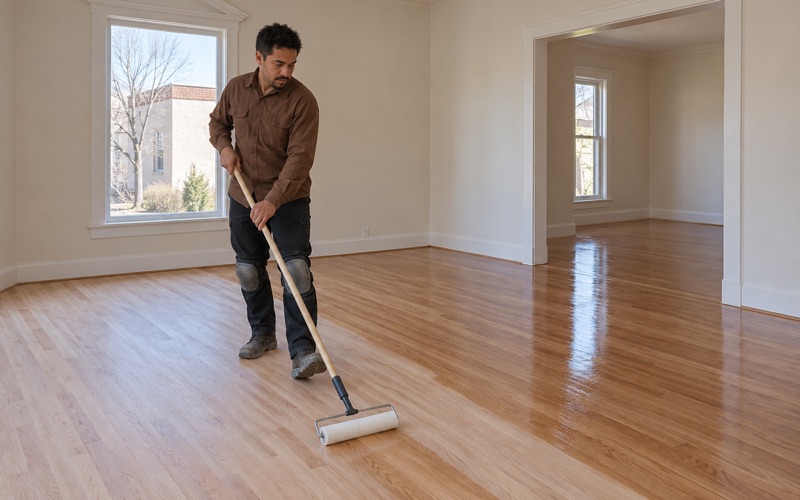
A floor from the townsite’s early decades has usually been through more than one sanding, and every pass removes wood that does not come back. Before we quote a full refinish, we look at the tongue depth at a floor vent or threshold, check for boards that have been face-nailed or patched, and note where earlier sanding went too deep. That tells us whether the floor can take another full sanding or whether a screen and recoat is the wiser choice.
Lead-Safe Work Before Any Sanding
A house built before 1978 may carry lead in an old finish, paint on the baseboards, or dust in the gaps between boards. On pre-1978 housing we follow lead-safe work practices under the EPA Renovation Repair and Painting rule before any old finish is sanded, including containment and cleanup of the work area. We explain what that involves at the estimate so it does not come as a surprise on the first day.
Our dustless sanding system keeps most of the fine dust out of the air, and the grit sequence is chosen to cut through old coatings without gouging soft or thin boards. An edger and an orbital sander handle the perimeter and the corners where a drum sander cannot reach.
Floor Furnace Openings and Old Patches
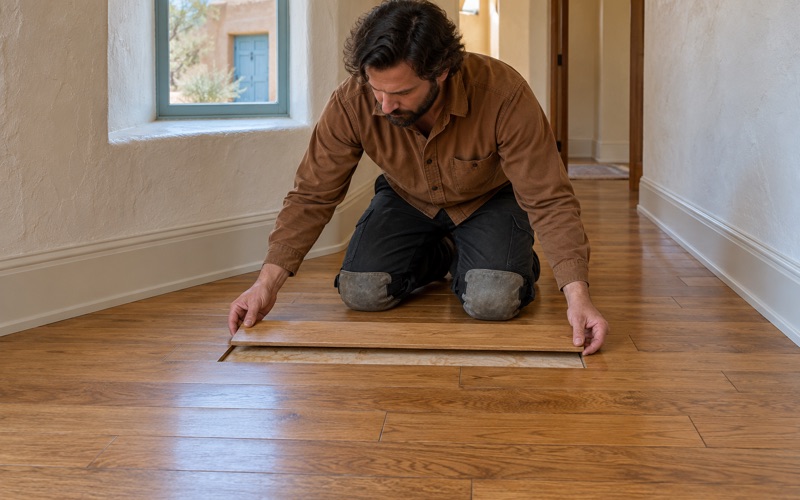
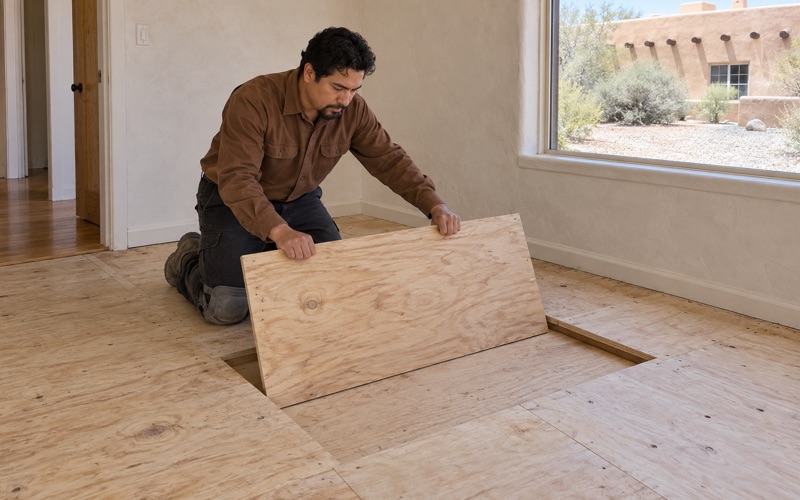
Houses from this period sometimes have an old floor furnace opening or a wall heater hole that was covered over with plywood or a mismatched board. We patch those with boards woven into the existing floor, staggered to follow the original layout, so the repair reads as part of the floor instead of a square in the middle of it. The same weave-in repair works for boards damaged by pet urine stains or old water spots.
After sanding, we talk through color. Many older floors were finished with oil-modified polyurethane that has ambered into an orange oak tone over the years, and some owners want that warmth while others want it gone. We offer waterborne polyurethane and hardwax oil finish options that meet the federal architectural coatings VOC limits, with low-odor choices for anyone staying in the house during the work.
Townhomes, Condos and Attached Units
Detached houses are the largest group, but they are far from the whole picture. One-unit attached homes make up 12.4 percent of the town’s housing units, and 18.1 percent of owner households live in one. Of the 5,975 occupied units, 66.5 percent are owner-occupied, so most of the floors we work on belong to people who will live with the result for years.
Working Around Shared Walls and Declarations
An attached home shares walls, and sometimes floor and ceiling assemblies, with a neighbor. Sanding noise, dust control and finish odor all carry further than they do in a detached house, so we plan the work hours and ventilation with that in mind. We also ask early whether the unit is part of a condominium, because under the New Mexico Condominium Act the declaration governs alterations beyond a unit’s own interior.
If the association has rules about flooring type, underlayment or work hours, we want to see them before we order anything. It is far easier to choose a floor that fits those rules at the start than to change course after the material has arrived.
Rentals and Written Estimates
Renter households here are concentrated in buildings of five or more units, and those floors take heavy traffic between tenants. For landlords, we write itemized estimates that can support security deposit itemization under New Mexico’s 30-day rule. Each line shows the repair, the area and the cost, so the paperwork holds up if a former tenant asks questions.
When a unit is between tenants, we give you a written cure schedule so you know when furniture can go back and when the unit can be shown again. A screen and recoat is often the fastest way to refresh a rental floor that is worn but still sound.
The Cerro Grande Fire and Planning Around Fire Season
The Cerro Grande Fire passed through Los Alamos on May 10 and 11, 2000. A U.S. Forest Service examination of the home losses found that about 200 single and multi-family structures were totally destroyed or irreparably damaged, and it attributed those losses to how easily the residential area ignited, which produced many house fires at once. That fire still shapes how the town thinks about every spring and summer.
The county’s wildfire plan was first approved in 2009 and updated in 2016 and 2022. It records that the 2011 Las Conchas fire burned over 100,000 acres to the south, west and north of the town, with the old Cerro Grande burn scar serving as a massive firebreak, and that the Cerro Pelado fire in spring 2022 came within a few miles of the county. For us, that history means planning floor work around fire season rather than treating spring and summer like any other months.
Smoke, Ash and Floors
When smoke hangs over the mesas or ash settles during a fire nearby, fine grit gets tracked inside on shoes and blown in through doors. That grit is abrasive, and on a wood floor it acts like fine sandpaper underfoot, dulling the finish in walkways. We suggest dry dust mopping and a vacuum with a soft floor head rather than wet mopping, since water spreads ash into the seams.
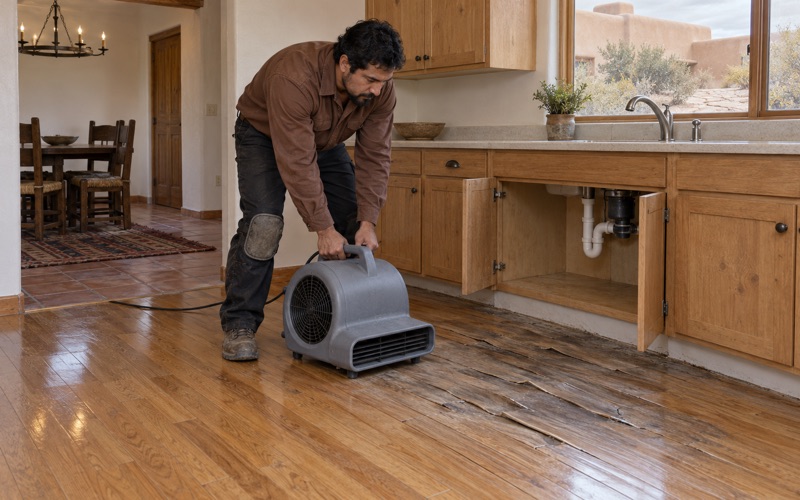
If smoke or ash has already dulled a floor, a screen and recoat often restores it without full sanding. Where finish has worn through, or water from a leak or a burst line soaked the boards, we trace the moisture to its source, take readings and photos, and document them in a form an adjuster can use.
Scheduling Around Dry Seasons and Storms
The wildfire plan puts total annual precipitation at about 18 inches, but notes that it now arrives as prolonged dry periods broken by intense local storms. The town falls in the National Weather Service Jemez Mountains forecast zone, and we check its forecasts before a sanding or refinishing job. Long dry stretches pull wood toward a low equilibrium moisture content, so we prefer to get indoor humidity steady before sanding and to apply the finish while conditions are stable.
For many households, a whole-house humidifier and a hygrometer are the simplest ways to hold the written target we leave behind. A floor that stays within its range through the driest months is a floor that keeps its finish and its seams, whatever the season brings.
- 20+ Years Experience
- Written Moisture Readings
- Itemized Written Estimates