Santa Fe Wood Flooring brings more than 20 years of work to wood flooring in Lamy, from sanding and refinishing to board repair, new installation and the humidity planning a dry climate demands. We come to the house, read the floor before recommending anything, and put the plan in writing so you know what will happen and in what order.
Most homes we are asked about here fall into one of two groups, and they need different thinking. An older house usually calls for assessment first: what the boards can still give, what has failed underneath, and whether an old finish needs lead-safe handling before any sander touches it. A house from the 2000s is more often a refinish or a repair on a floor that is still fairly young and has simply worn or dried out.
In both cases we take moisture readings in the wood and the subfloor before any material is ordered, and we write them down. Our estimates are itemized, so every line of the job can be read and questioned. Here is how we approach each kind of floor in this community.
Wood Floors in a Railroad Junction Village
Lamy is a census-designated place in Santa Fe County, about 18 miles south of the city of Santa Fe, and it grew up around the railroad. The Atchison, Topeka and Santa Fe Railway reached Santa Fe in 1880 through a junction here, where the tracks split north toward the city while the main line ran on toward Albuquerque. The place was first called Galisteo Junction and was later renamed for Archbishop Jean-Baptiste Lamy.
The depot and a shrinking town
The station that stands today is the second one. The AT&SF built its Mission Revival depot in 1909, of brick covered in stucco, and it replaced a two-story wood-frame structure put up in 1881. Amtrak’s Southwest Chief still stops at Lamy daily in each direction.
A station history draws a straight line between the railroad and the size of the village. As the railroad industry grew, development here grew with it, and as the industry declined, so did the need for railroad workers, which led to a shrinking population. The 2020 census counted 210 residents.
What that history left behind
That rise and decline shows up in the housing. The American Community Survey 2024 five-year estimates count 153 housing units in Lamy, and 44 of them were built in 1939 or earlier. After a long quiet stretch, a second wave arrived: 58 units date from 2000 to 2009, and the survey records none built since 2010.
Nearly all of it is single-family. About 78 percent of units are one-unit detached houses and the rest are one-unit attached, with no mobile homes reported. The estimates for a place this small carry wide margins, so we treat them as a picture of the stock rather than a precise count, but the two-cohort shape is clear, and it is why a floor job here usually starts with a simple question: which kind of house is this?
Looking for wood-flooring closer to Pojoaque? See Pojoaque Wood-Flooring.
Assessing and Repairing Floors in Lamy’s Pre-1940 Houses
An old floor in a small detached house rewards patience. We do not assume what species is down, what is under it or how many sandings it has already had; we look, measure and then recommend. The goal is usually to keep sound wood in place, fix what has failed and take off no more material than the boards can spare.
Reading the boards before any sanding
We start by checking how much wood is left above the tongue, often by lifting a floor register or looking at a board edge at a threshold. Floors that have been sanded several times over the decades may have little wear surface left, and a full drum sander pass could expose tongues or nail heads. Where the margin is thin, a lighter approach, such as a screen and recoat or a careful sanding with a finer grit sequence, keeps the floor in service longer.
We also note cupping, crowning, loose boards and earlier repairs that never matched. Each one points to a cause, and a floor refinished without addressing the cause tends to show the same problem again within a season or two. A cupped board, for example, usually means moisture is reaching it from below, and sanding it flat before that is fixed only sets up the opposite problem, crowning, once the wood dries.
Humidity questions and old heat openings
Gaps between boards, checking and splitting on the face, and squeaks that return each winter are usually a humidity question first and a carpentry question second. We read the moisture content of the wood with a wood moisture meter, compare it to the equilibrium moisture content the house actually holds, and give you a written indoor relative humidity target. Where a whole-house humidifier would help, we say so; where it would not, we say that too.
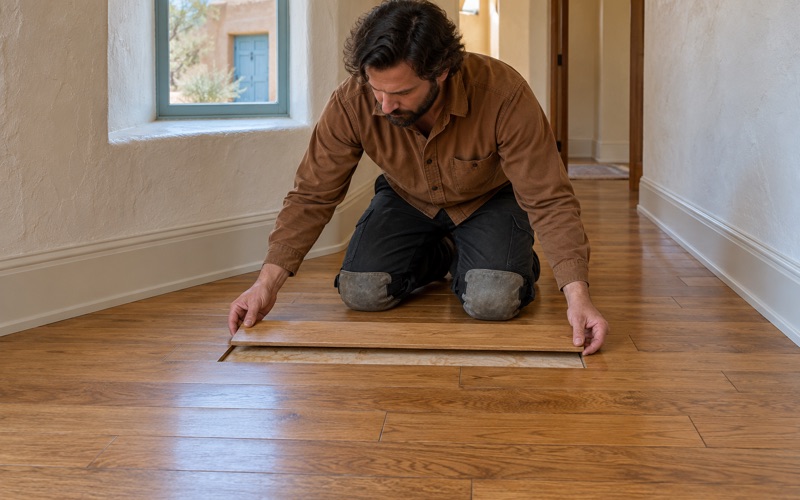
Older houses often carry the marks of earlier heating, such as a floor furnace opening or holes left by a wall heater. We patch those with boards woven into the existing floor, staggering the joints so the repair reads as part of the layout rather than a square filler. Loose or split boards elsewhere get the same board replacement treatment before the room is sanded.
Lead-safe work on old finishes
Every one of the 44 pre-1940 units predates 1978, and at least 69 units in Lamy predate 1980, so the federal EPA Renovation, Repair and Painting rule is relevant to painted trim and baseboard work. Before we sand any old finish in a pre-1978 house, we set up lead-safe work practices: containment, a dustless sanding system on the drum sander and edger, and careful cleanup at the end of each day. That step comes before any decision about stain or sheen.
Refinishing Floors Put Down in the 2000s
The 58 units from 2000 to 2009 are a different job. Their floors are roughly two decades old, which is often the point where a finish has worn through in walkways, color has faded unevenly near windows, or a few boards have dried and opened up. The wood itself is usually sound, so the work is more about renewing the surface and correcting what the first installation missed.
Finish wear, sun fading and color
Sun fading near bright windows and orange oak from an aging oil-based finish are two of the most common complaints on floors of this age. A full sanding removes the old color and lets us reset the tone, and we test stain on a sample board in your own light so a blotchy stain on maple or a too-dark result on red oak is caught before it covers the room. If the finish is dull but intact, a screen and recoat restores it in far less time.
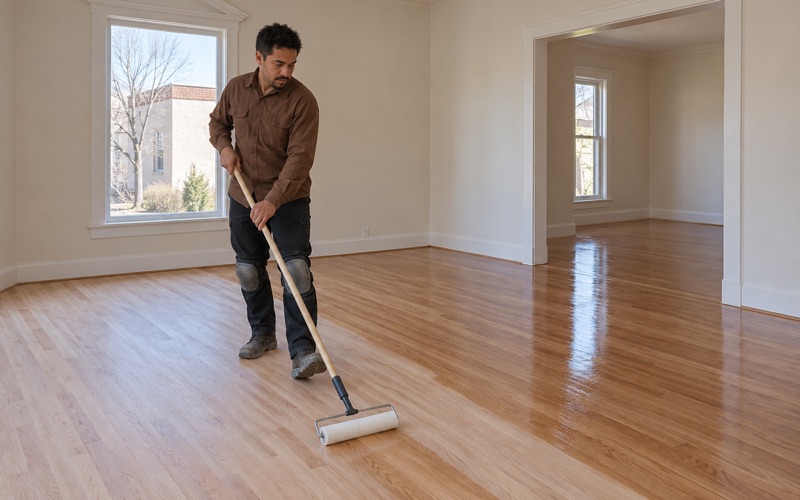
For the new coats, we use finishes that meet the federal architectural coatings VOC limits in 40 CFR 59 Subpart D. Waterborne polyurethane is the low-odor option for a household staying in the house during the work, while oil-modified polyurethane or a hardwax oil finish suits owners who want a warmer look and can plan around a longer cure.
Repairs on younger floors
A 2000s-era house may have engineered flooring rather than solid hardwood, and that changes what a repair can do. The wear layer thickness decides whether an engineered floor can be sanded at all, so we measure it before promising a refinish. A floating installation that has buckled or pulled apart at the edges often traces back to a missing expansion gap, and we fix the cause rather than just the boards.
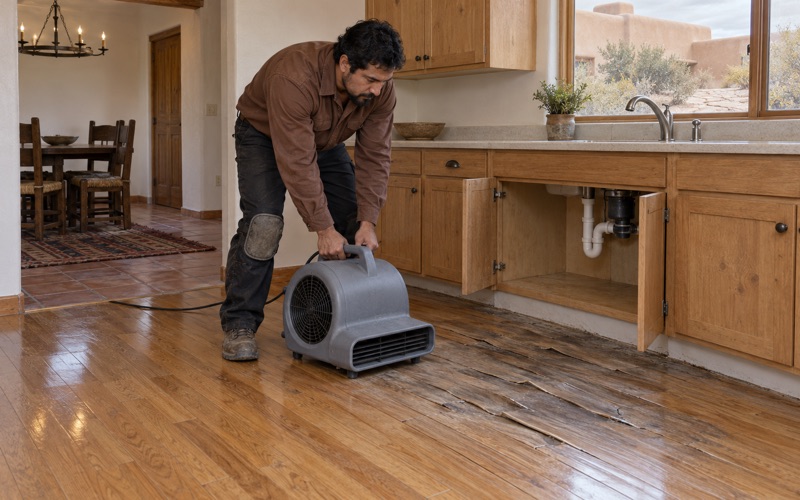
Where a house has hydronic radiant floor heating, we plan any replacement or new installation to the NWFA radiant heat guidelines, which cap the floor surface at 80 degrees Fahrenheit and limit temperature changes to 5 degrees a day. A nightly setback is off the table under the same guidelines, and we go over the thermostat with you before installation. If water damage is part of the problem, we trace it to its source, including a leak in a radiant heat line, and document it with photos and moisture readings an adjuster can use.
Planning Floor Work Around a Small, Detached Stock
A village of about 150 homes means most jobs are one house at a time, often a single room or two. The ACS counts 128 occupied units here, 82 owner-occupied and 46 renter-occupied, and every renter household rents a detached house. That mix shapes how we schedule and document the work.
Owners and landlords
Owners living in the house usually want the job staged so part of the home stays usable, and we plan the room order around that. Landlords between tenants want speed and paperwork, so we write itemized estimates that separate normal wear from damage such as pet urine stains or peeling polyurethane, which helps when itemizing deposit deductions under New Mexico’s 30-day rule.
If a house is used as a short-term rental, we schedule the work around bookings and give you a written cure schedule, so the unit is back in service on a known date. Furniture, rugs and full foot traffic each get their own return date on that schedule, in writing rather than left to guesswork.
Materials, acclimation and edges
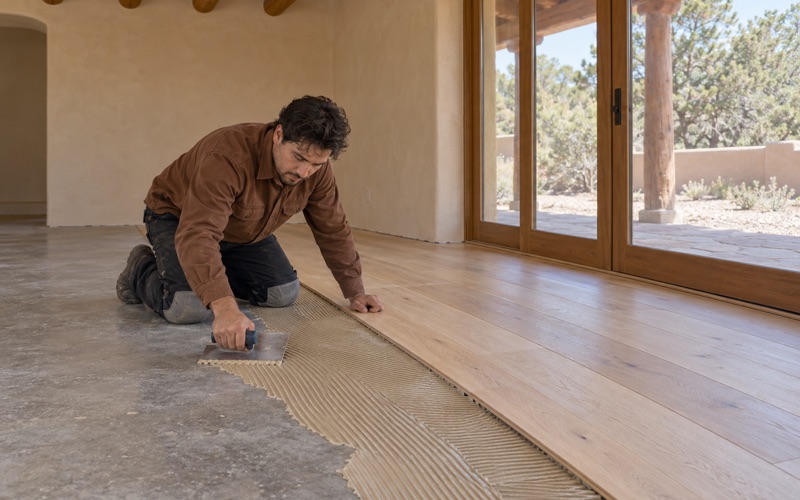
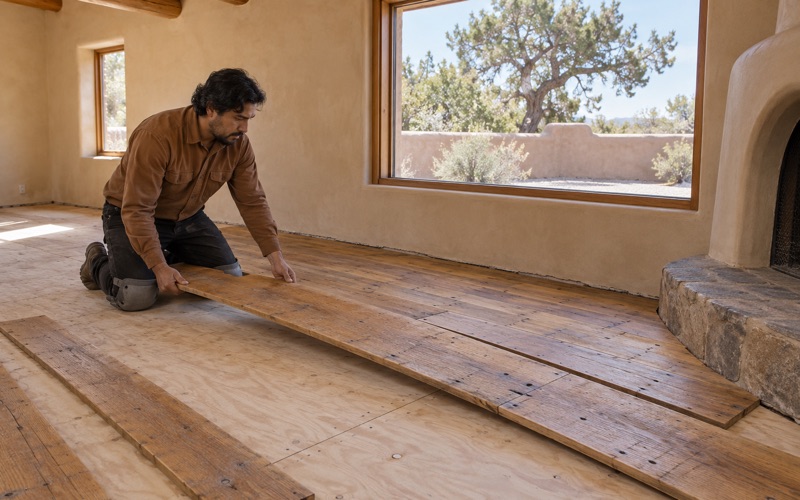
New or replacement wood has to settle to the house before it goes down. Reclaimed and wide plank boards milled somewhere wetter will shrink in this dry air, so we let them acclimate indoors until the moisture readings level off. Skipping that step is how a wide plank floor opens up in its first winter.
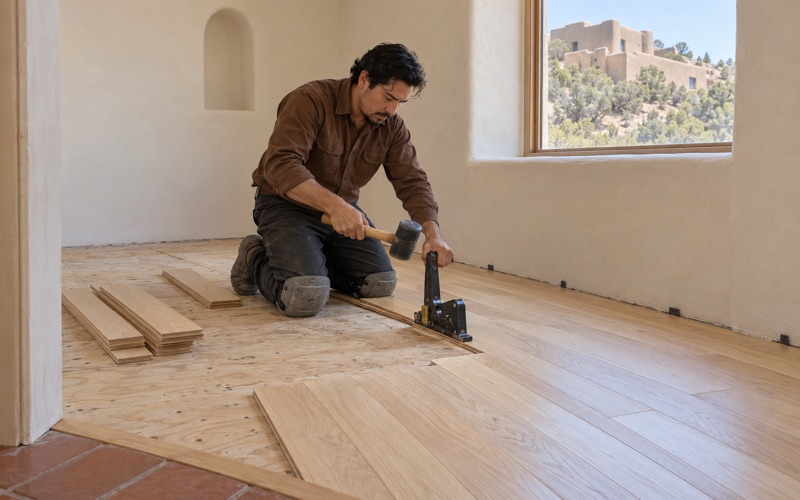
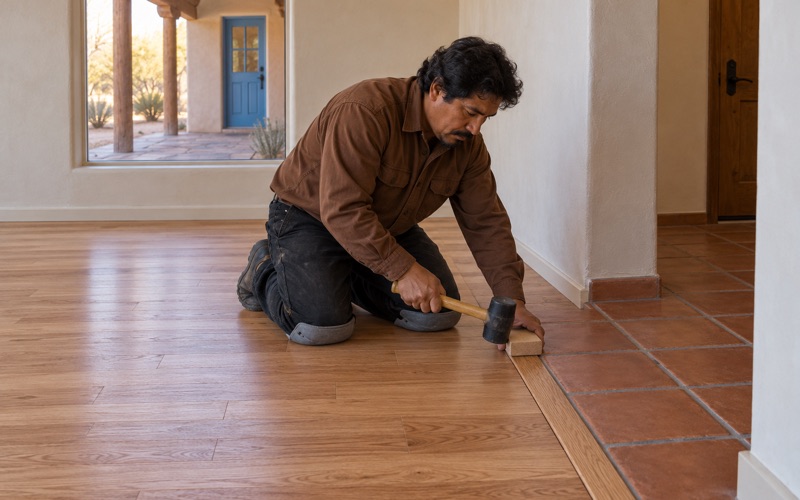
Where wood meets Saltillo tile, brick or flagstone, we plan the transition before installation. A flush joint, a reducer strip or a T-molding is chosen so there is no lip to catch a toe and no gap to collect grit at the doorway. We set the height of the wood during installation so the finished surfaces meet the way the transition was drawn.
Timing and weather
Lamy falls in the National Weather Service Santa Fe Metro Area forecast zone, NMZ218. Seasonal swings in the weather move indoor humidity, so we time acclimation and finishing around the readings in your house rather than the calendar alone. In practice that can mean letting a stack of boards sit an extra week, which costs far less than a floor that gaps in January.
Whether your floor is in a pre-1940 house that needs a careful assessment or a 2000s home that needs its finish renewed, the first step is a visit. Call Santa Fe Wood Flooring, and we will measure, explain what we find and give you a written plan for the work.
- 20+ Years Experience
- Written Moisture Readings
- Itemized Written Estimates