
Santa Fe Wood Flooring repairs hardwood floor water damage in Santa Fe, NM, serving surrounding cities including Agua Fria, La Cienega, Eldorado at Santa Fe, Valencia and Lamy. Over 20+ years of wet-floor repairs, the lesson has stayed the same: a water-damaged wood floor is only fixed once the source is found and the whole wet area is known, not just the stain you can see.
Water reaches wood floors here from more directions than people expect. A leak in a hydronic radiant heat line under a slab, a failed dishwasher hose, a water heater giving out in a closet and a flash flood running across a yard can all end with cupped or buckled boards, and each needs a different response.
We trace the water to its source, map the wet area with moisture readings, photograph everything before tear-out and then decide, with numbers, which boards can be dried and saved and which need to come out.
Where the Water Came From
Radiant Heat Line and Slab Leaks
In a house with in-slab radiant tubing, a leak shows up as a warm, damp area or a patch of boards cupping in the middle of a room with no plumbing fixture nearby. A slab leak in a domestic water line can look the same.
We map the wet zone with a moisture meter so the plumber knows where to open the slab, then lift only the boards needed for access. Boards that come up carefully can often be dried and reinstalled after the line is repaired.
Appliance, Plumbing and Water Heater Leaks
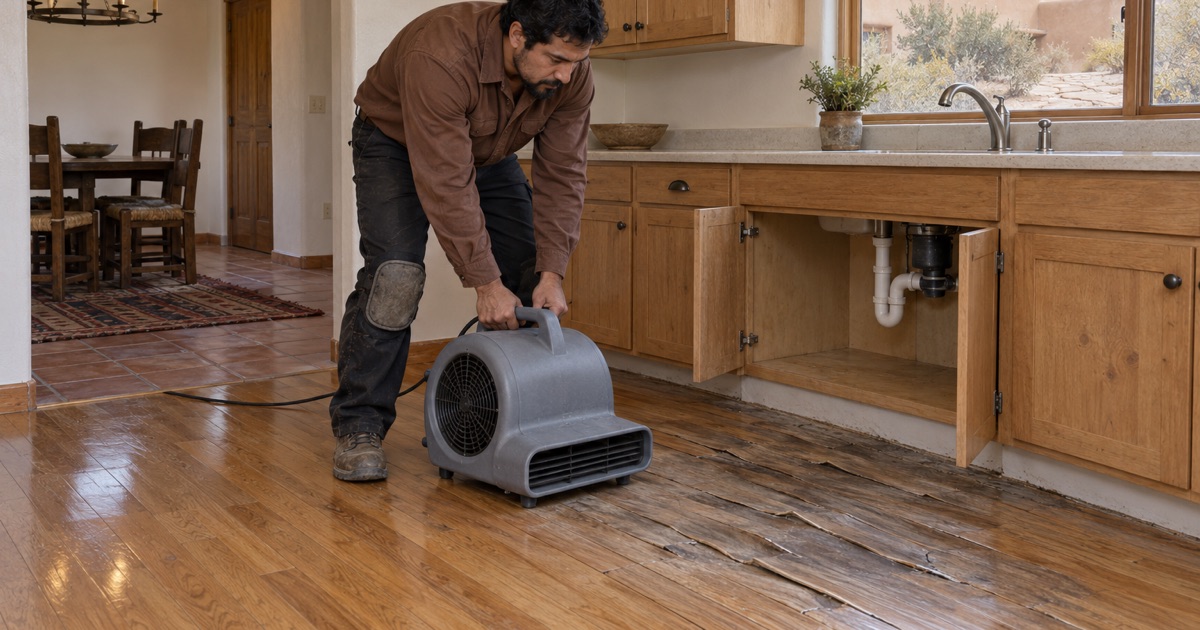
Icemaker supply lines, dishwasher hoses, washing machine connections and water heaters leak slowly, and the water spreads under the floor long before it shows at the surface. By the time a board lifts at the kitchen edge, the wet area can extend well into the next room.
We read moisture beyond the visible damage in every direction until the numbers return to normal, so the repair covers the actual wet area rather than just the boards that look bad.
Flash Floods and Water From Outside
The City of Santa Fe describes flash floods as its most common type of flooding, with arroyos that are dry most of the year filling quickly. The city also notes that FEMA maps mainly show stream overflow, not overland flow like this, so a house outside a mapped zone can still take water through a door.
Outside water brings silt and debris, and it soaks the subfloor as well as the boards. We check how high it rose, how long it sat and what it carried in before deciding what can be saved.
Reading the Damage in a Wet Wood Floor
Cupping, Crowning and Buckling
Cupping is when the edges of each board rise above the center, because the bottom of the board has taken on more moisture than the top. Crowning is the reverse, often caused by sanding a cupped floor before it dried. Buckling is when boards lift right off the subfloor because they have run out of room to expand.
Each tells us something about how much water got in and for how long. Mild cupping often recovers as the floor dries; buckling usually means replacement.
Moisture Mapping the Wet Area
We take readings on a grid across the floor and beyond, in the boards and in the subfloor or slab, and mark where they return to the dry baseline of the unaffected floor. That map sets the edge of the repair.
The same readings, repeated over the following days, show whether the floor is drying evenly and when it is ready for the next step. A reading that stalls tells us water is still getting in somewhere.
Stains, Subfloor Damage and Mold Risk
Water reacting with the tannins in oak leaves gray and black stains that often go deeper than sanding can reach. Plywood and OSB subfloors that stayed wet can delaminate or swell, and a floor wet for days is worth checking for mold on the underside of the boards.
We lift sample boards where needed to see the subfloor, and we recommend a remediation specialist before any new wood goes down if we find more than minor surface staining.
Drying, Saving or Replacing the Floor
When a Wet Floor Can Be Saved
A solid hardwood floor that was wet for a short time, with the source stopped quickly, can often be dried back to its normal moisture content. It may need some boards replaced and a refinish once it is flat again, but most of the floor stays.
We dry floors under controlled conditions and monitor the readings rather than forcing them. In a dry climate the air does much of the work on its own, and drying too hard causes checking and crowning of its own.
Removing and Replacing Damaged Sections
Boards that are black-stained through, delaminated, or buckled off a failed subfloor are removed. We cut back to sound wood, repair or replace the subfloor as needed, and weave new boards into the existing rows so the repair has no straight seams.
For engineered floors, the core type decides a lot. Plywood cores often recover; fiberboard cores that have swelled do not, and glue-down floors that have lost their bond to the slab are removed in that area.
Refinishing After the Floor Has Dried
Once the readings show the floor has returned to its normal range and stayed there, it can be sanded and refinished. Sanding earlier locks in any remaining cup as a crown once the last moisture leaves.
We sand the repaired area together with the surrounding floor, or the whole room where needed, so the new boards and the old match in color and sheen. A repair finished on its own tends to show as a lighter or glossier patch.
Insurance and Documentation for Water Damage
Photos and Readings an Adjuster Can Use
An adjuster wants to see the extent and the cause. We photograph the damage before anything is removed, record moisture readings on the grid, note the source and keep an itemized estimate that separates removal, drying, subfloor repair, new material, installation and refinishing.
That documentation helps you whether or not you file a claim, and it keeps the record straight if the job is reviewed later. Copies go to you, not only into our files.
Asking Your Insurer a Question First
New Mexico’s Office of Superintendent of Insurance has said that an inquiry about damage is not a claim when no payment is made. For owners unsure whether a wet floor is worth claiming, that can make it easier to ask before deciding.
What a policy covers, and how any claim is settled, is between you and your insurer. We supply the evidence and the estimate; we do not make promises about coverage.
Repair Help for Qualified Homeowners
Santa Fe Habitat for Humanity runs a home repair program that includes floors, for qualified low-income homeowners, senior citizens and disabled individuals on fixed incomes, with assistance given as a grant that does not have to be repaid.
If a water-damaged floor is more than a household can manage, it is worth asking whether the program applies. We are happy to provide measurements and an estimate for that application.
- 20+ Years Experience
- Written Moisture Readings
- Itemized Written Estimates