Santa Fe Wood Flooring installs, repairs and refinishes wood flooring in Alcalde for owners who want to know what their particular house can carry, and we bring more than 20 years of that work to every job. Much of it here starts with a question other flooring crews skip: is this a manufactured home or a site-built house? The answer changes the product, the installation method and the transition at every doorway.
We measure moisture before anything is ordered, in the boards, in the subfloor and in any concrete, and we write the readings down so you can see them. We also give you a written indoor humidity target, because in dry northern New Mexico air most gaps, checks and winter squeaks come back to humidity rather than a bad board.
The sections below cover wood in singlewides and doublewides, the checks we make under a manufactured home floor, the choice between engineered and solid wood, and the older and newer site-built houses in the valley. The last section covers what owners and renters should sort out before a crew arrives.
Wood Floors in Alcalde’s Manufactured Homes, and What We Check First
Manufactured homes are a large share of Alcalde’s housing, not a footnote. Census estimates count 59 of the community’s 153 housing units as mobile homes, nearly four in ten, with a margin of error of plus or minus 23. They house 25 owner households and 17 renter households, which is more than half of the 32 renter households in Alcalde.
That share shapes how we quote here. A singlewide or doublewide floor is its own kind of project, and treating it like a site-built house is how a new wood floor ends up squeaking, gapping or catching every door in the first year.
Reading the Floor Before Choosing a Product
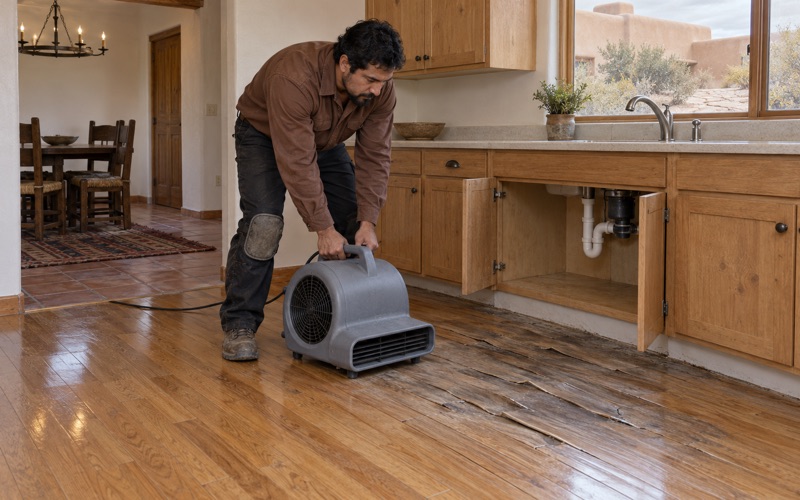
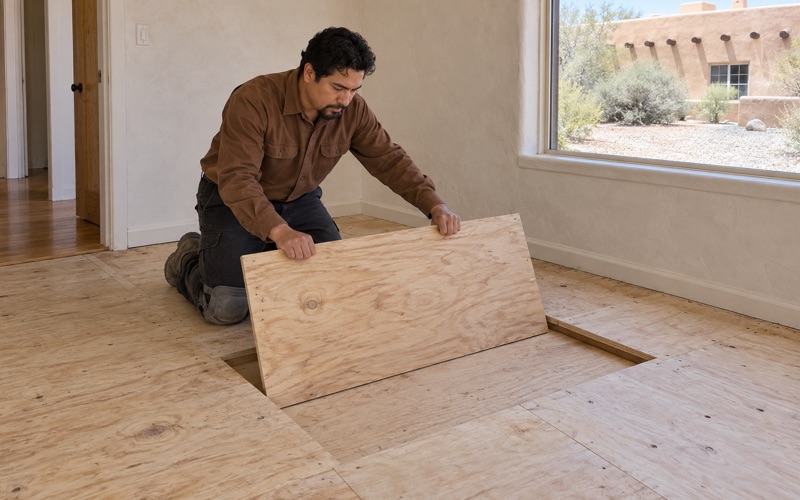
We start by identifying what the existing floor decking is made of rather than assuming, because that material decides whether cleats, staples or adhesive will hold. We walk the whole floor for soft spots, especially near the kitchen sink, the water heater, the washer and the bathrooms, where an old plumbing leak can leave decking that flexes underfoot. A soft area gets opened, dried and repaired before any wood goes over it.
Then we take moisture content readings across the decking with a wood moisture meter and record them beside the readings from the new flooring. When the two are too far apart, the boards wait until they come into line, since wood laid over a wetter or drier base will cup, gap or squeak within a season.
In a doublewide we also check the floor where the two halves meet, since any difference in height or flatness along that seam telegraphs through a floating floor. We flatten it before installation rather than counting on the underlayment to hide it.
Height, Doors and Transitions
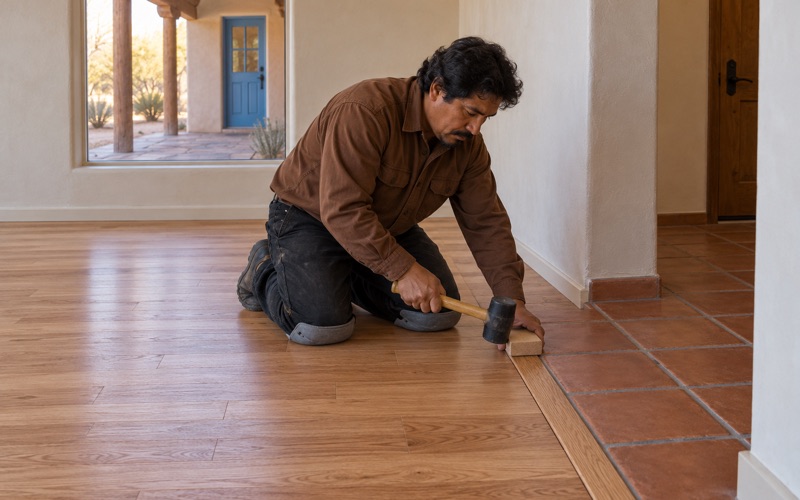
Adding wood raises the floor, and in a manufactured home that small change shows up quickly at exterior doors, interior doors and the joint where a hallway meets a bathroom. We measure door clearances before choosing a board thickness and plan to trim doors where needed. Where wood meets vinyl, carpet or tile, we choose a reducer strip or T-molding for that exact height difference instead of leaving a lip to catch a toe.
Water Damage We Find Along the Way
Pulling up old carpet or vinyl sometimes shows staining or rot that nobody knew about. When that happens we trace the water to its source before replacing anything, and we document it with photos and moisture readings an insurance adjuster can use.
If a leak runs back to a supply line or drain, the plumbing repair comes first and the floor second. Laying new wood over decking that is still wet only hides the problem under a nicer surface.
Looking for wood-flooring closer to Agua Fria? See Wood-Flooring in Agua Fria.
Engineered Wood Versus Solid Wood in a Singlewide or Doublewide
Both engineered and solid wood can work in a manufactured home, but they suit different conditions, and we lay the tradeoffs out in the estimate rather than steering every job to one product. The deciding factors are the decking, the floor height you can spare and how much the indoor humidity swings from summer to winter.
Engineered Wood
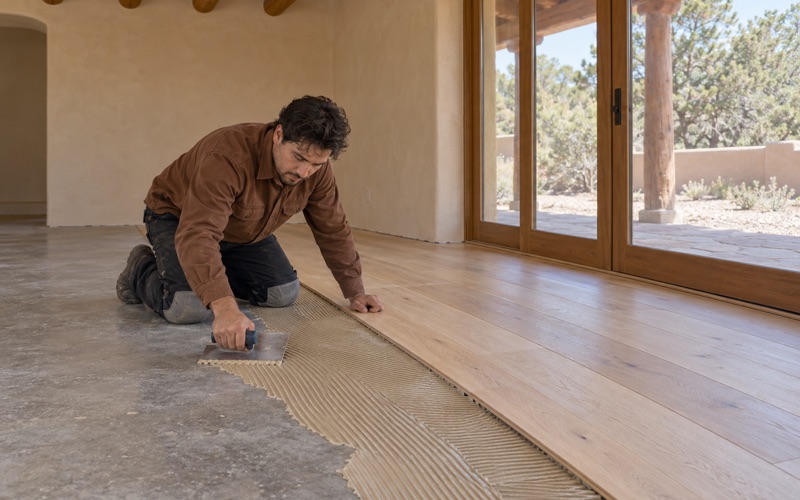
Engineered wood has a real hardwood wear layer bonded over a cross-layered core, and that engineered core construction resists the shrink and swell that opens gaps in solid boards during a dry winter. It can go down as a floating installation over an underlayment, or as a glue-down installation where the decking is sound and flat. Thinner profiles keep the added height small, which matters at the doors described above.
Wear layer thickness is the number to ask about. A thicker wear layer can be sanded and refinished more than once over the life of the floor, while a very thin one may allow only a screen and recoat before the core shows through.
Solid Wood
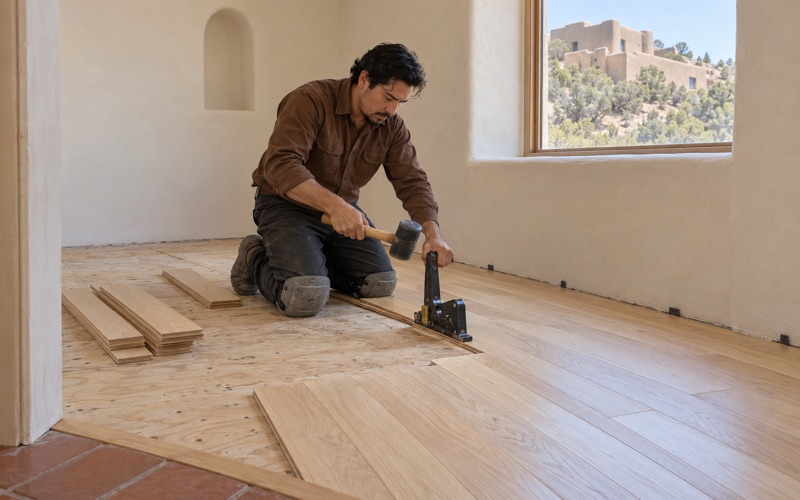
Solid hardwood is usually nailed down with cleat nails or flooring staples, so it needs decking that holds a fastener firmly across the whole floor. Where it does, red oak, white oak, hickory and maple all make durable floors, and a higher Janka hardness rating helps a busy hallway resist dents. Solid boards move more with the seasons than engineered ones, so acclimation and a steady indoor humidity matter even more.
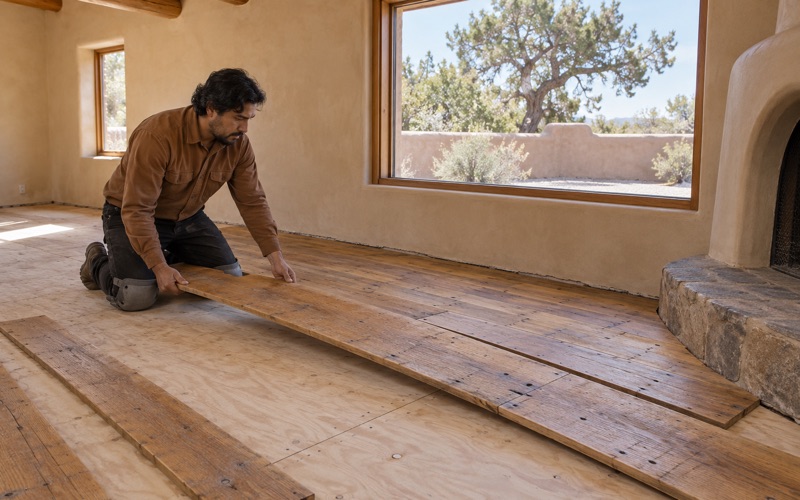
Wide plank and reclaimed wood deserve extra time before installation. Boards milled somewhere wetter can open up in their first New Mexico winter, so we let them acclimate inside the house and check their moisture content until it matches the target we set for the home.
Finishes for Occupied Homes
Many manufactured homes stay occupied during floor work, and a compact floor plan puts every room close to the fumes. We use finishes that meet the federal architectural coatings VOC limits under 40 CFR 59 Subpart D, including low-odor waterborne polyurethane, and we give you a written cure schedule so you know which rooms are usable and when.
Oil-modified polyurethane is still available where an owner wants its amber tone, but it carries more odor and a longer cure. We recommend it mainly for homes that can stand empty for a few days.
Floors in Alcalde’s Site-Built Houses, Pre-1940 to Today
The houses beside Alcalde’s manufactured homes cover a long run of building years. Census counts show housing units from every decade, with 22 built in 1939 or earlier, 14 in the 1940s and 75 from 1990 through 2019, and none recorded as built since 2020. A floor job in one of the oldest houses and a job in a 2010s build can call for very different preparation.
Older Houses and Lead-Safe Sanding
Sixty of Alcalde’s housing units were built before 1980, and a house built before 1978 may carry lead in its old finish, paint or trim. Before we sand an old finish or disturb painted baseboards in one of those houses, we set up lead-safe work practices under the EPA Renovation, Repair and Painting rule, including containment and cleanup. A dustless sanding system cuts airborne dust but does not replace those steps.
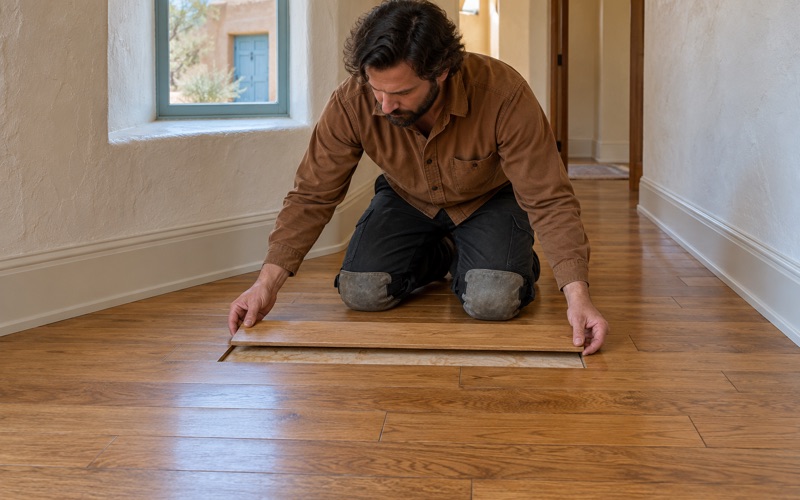
Older houses also carry patches from earlier heating. Where an old floor furnace or wall heater once sat, we weave matching boards into the existing floor so the repair follows the grain and does not read as a square patch.
Newer Houses, Concrete and Radiant Heat
Houses from the 1990s through the 2010s each get their own subfloor test before we order material. Where a floor sits over concrete, we run a calcium chloride moisture test or an in-situ relative humidity test and choose a vapor retarder to match the result.
Where a newer house has hydronic radiant floor heating, we follow the NWFA radiant heat guidelines, which cap the floor surface at 80 degrees Fahrenheit and limit temperature changes to 5 degrees a day. Those limits rule out a setback thermostat, so we talk through the heating schedule with you before the wood goes down.
Refinishing Instead of Replacing
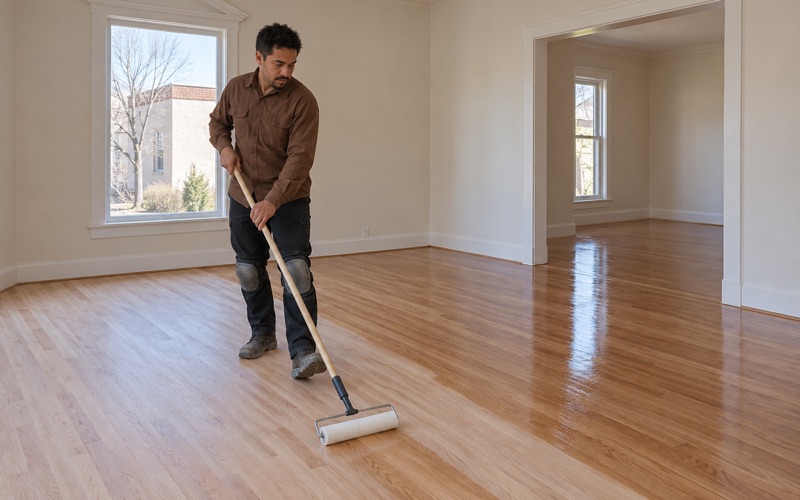
Not every older floor needs new boards. A screen and recoat freshens a sound finish, while a full sand and refinish with a drum sander, edger and a proper grit sequence removes peeling polyurethane, sun fading, blotchy stain or the orange cast old oak finishes take on. Board replacement handles pet urine stains that have soaked into the wood.
We also match the sheen level to the room. A satin or matte finish hides the fine scratches of daily traffic better than high gloss, and a hardwax oil finish suits owners who prefer spot repairs to a full recoat.
Owners and Renters Planning Floor Work
About three quarters of Alcalde’s occupied units are owner-occupied, but the renters here are split almost evenly between detached houses and manufactured homes. That mix means we plan for an owner choosing a floor for the long term and for a landlord turning over a rental on a deadline.
Assessor Paperwork Is Separate From Floor Work
Rio Arriba County’s Assessor handles the records that follow a manufactured home. Moving permits cost $10 for a singlewide and $20 for a doublewide, a tax release starts with an application form, and all outstanding prior and current taxes must be paid in full when the release is issued. The Assessor also keeps a procedure for deactivating a manufactured home’s title so it is classified as real property.
None of that is a flooring task, and we do not file it for you, but it can shape the job. If the home may be moved, or its title is being converted to real property, tell us at the estimate so the floor, trim and transitions fit where the home is headed.
Landlords and Tenants
For rentals we write itemized estimates that separate normal wear from damage, which landlords can use when itemizing security deposit deductions under New Mexico’s 30-day rule in the Uniform Owner-Resident Relations Act. Tenants who want floor work should get the owner’s approval first, since the floor belongs to whoever owns the home.
Census counts show only four vacant units in Alcalde held for seasonal or occasional use. Where one of those is rented between stays, we schedule the work around bookings and put the return-to-service date in writing.
Scheduling Around the Household
Floor work in a small home touches every room, so we sequence it to bring kitchens and bathrooms back into use first where the layout allows. You get a written cure schedule with dates for light foot traffic, furniture and rugs, plus the written humidity target that keeps the new floor stable through its first dry winter in the Espanola Valley.
- 20+ Years Experience
- Written Moisture Readings
- Itemized Written Estimates