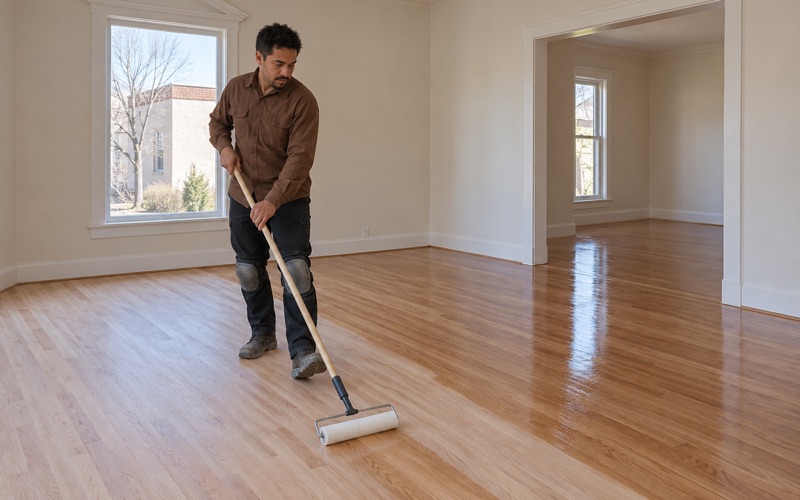
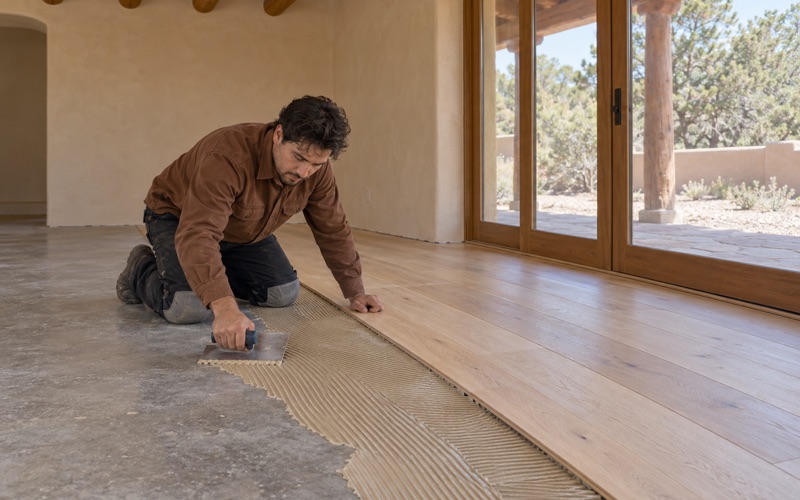
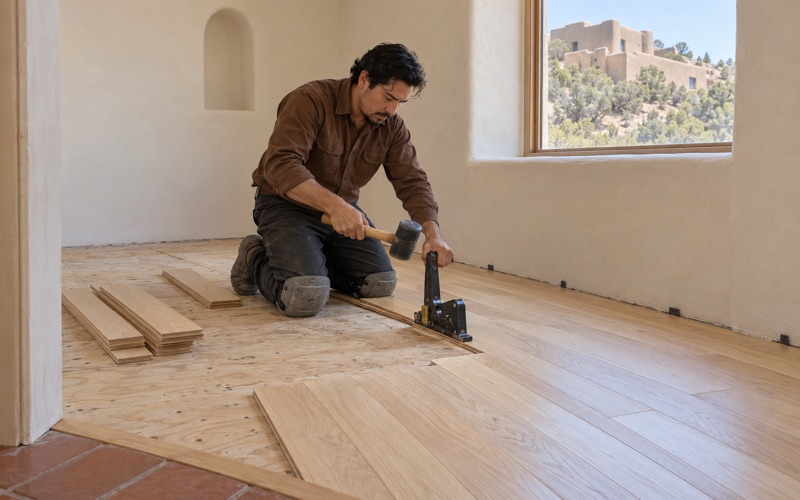
Santa Fe Wood Flooring handles wood flooring in Agua Fria with more than 20 years in the trade behind every installation, refinish and repair. We install solid hardwood and engineered floors, sand and recoat worn ones, rebuild damaged sections board by board, and plan the details that make a floor last in a high, dry climate.
The work here tends to split into two kinds of job. Some homes are older houses that need careful repair and refinishing, where the goal is to keep what is there and make it sound again. Many more are newer homes where the question is simply which floor fits the rooms, the budget and the way the household lives.
Either way, we start the same way: moisture readings written down before anything is ordered, a clear scope, and an itemized estimate you can read line by line. Below is how we approach both kinds of project in this community.
Wood Floor Work in a Traditional Historic Community
Agua Fria is not part of the City of Santa Fe. It is an unincorporated census-designated place in Santa Fe County, and the heart of it, the Village of Agua Fria, carries a county designation as a Traditional Historic Community. That status shapes what the area looks like, and it helps explain why a single street can hold very different houses.
What the designation says
Santa Fe County Ordinance No. 2004-1, passed April 13, 2004, describes the Traditional Historic Community area as an identifiable village documented as being in existence for more than 100 years. The same ordinance says the area includes structures or landmarks associated with the identity of the place traditionally known as the Village of Agua Fria, with a distinctive character that can be distinguished from surrounding areas or new development nearby.
The Santa Fe Board of County Commissioners designated the village in 1995, and County Ordinance No. 1996-16 formalized that status and set the first boundary. Wikipedia records the first settlement around 1640 and 57 families living here by 1776, and the village has two historic plazas, La Placita de Los Romeros and La Placita de Los Lopez.
A boundary that keeps changing
The line around the village has not stood still. The county has amended the boundary several times, through Ordinances 2004-1, 2006-12 and 2008-18, and most recently in 2023, when the Board of County Commissioners unanimously approved adding part of what was called Area 1B. The county notes that the ordinance reflects the default Agricultural/Ranching (A/R) zoning for areas included in the Village of Agua Fria Traditional Historic Community.
For a homeowner, the practical point is modest. The designation and the A/R zoning describe the village and its land. When a project raises a question about either, we point you to Santa Fe County rather than guess, and we keep our own scope to the floor inside your walls.
Looking for wood-flooring closer to La Cienega? See Wood-Flooring Services in La Cienega.
Most of the Village Was Built Since 1990
The historic identity is real, but the housing count tells a second story. The American Community Survey 2024 five-year estimates put Agua Fria at roughly 1,471 housing units, and about two-thirds of them were built in 1990 or later. The single largest group went up in the 1990s, followed by the 2000s, with more added since 2010.
Only about 16 percent of units predate 1980. The ACS also estimates that roughly half of the units here are mobile homes, and that renters occupy about 57.6 percent of occupied homes. So most of the floors we see in Agua Fria are in houses that are a few decades old at most, and many of them belong to owners who rent them out.
Choosing a floor for a newer home
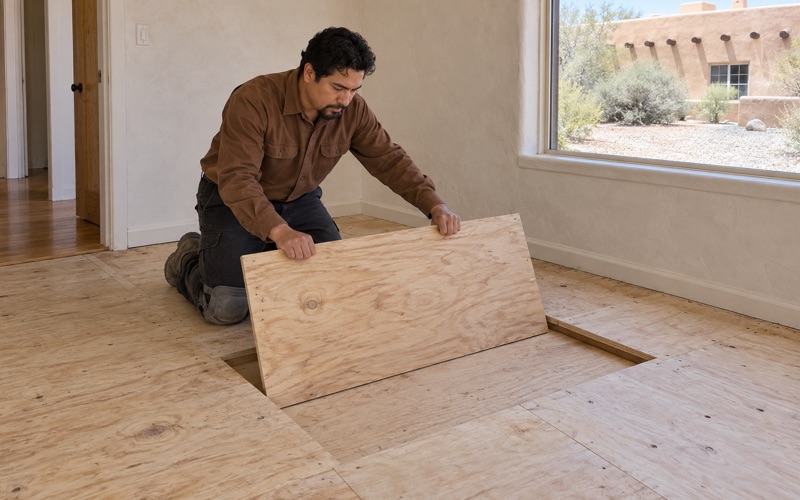
In a house from the 1990s or 2000s, the decision usually comes down to solid hardwood versus engineered flooring, and nail-down, glue-down or floating installation. Engineered core construction holds its shape better as indoor humidity swings between seasons, and a thicker wear layer leaves room for a future sanding. Solid white oak, red oak, hickory or maple can go over a sound plywood or OSB subfloor with cleat nails or flooring staples.
Where a floor goes over concrete, we run a calcium chloride moisture test or an in-situ relative humidity test before choosing a vapor retarder and adhesive. If the home has hydronic radiant floor heating or in-slab radiant tubing, we plan the installation to the NWFA radiant heat guidelines, which cap the floor surface at 80 degrees Fahrenheit and limit temperature changes to 5 degrees a day. Those guidelines rule out a setback thermostat entirely, so we settle the heat settings with you before the wood goes down.
Species choice matters as much as construction. The Janka hardness rating gives a rough guide to dent resistance: hickory and maple stand up well to dogs and dropped pans, while red oak and white oak take stain more evenly and sand again more forgivingly. Maple can turn blotchy under a dark stain, so we test a sample board in your own light before committing to a color.
Rentals and turnovers
With renters in most occupied homes, a good share of our Agua Fria calls come from owners between tenants. Pet urine stains, peeling polyurethane, deep scratches near entries and water marks by the kitchen sink are the usual list. For those jobs we write itemized estimates that separate normal wear from damage, which helps a landlord itemize deposit deductions within the 30 days New Mexico allows.
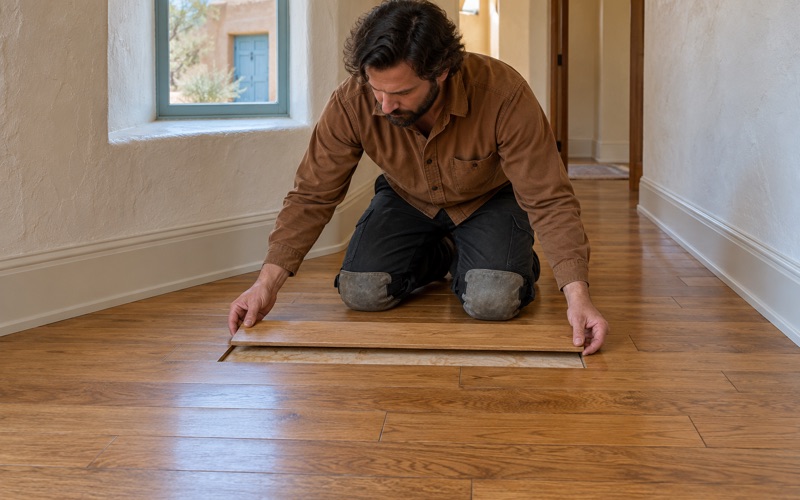
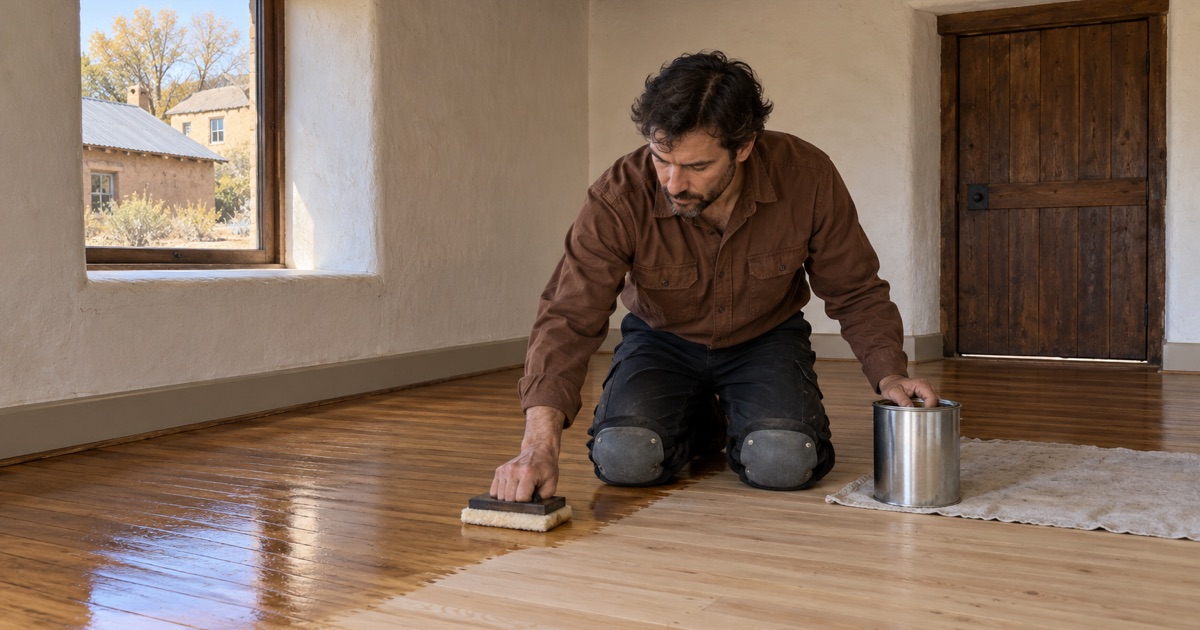
Not every worn floor needs a full sanding. A screen and recoat can restore a dull finish that has not worn through to bare wood, and it cures faster. Where boards are stained black or cupped, we replace them with matching stock and weave them in, then finish the whole room so the repair does not stand out. Short-term rental owners get a written cure schedule so the unit is back in service on a known date.
Caring for Floors in Older Village Houses
The older houses near the plazas call for a slower hand. We do not assume what is under an existing floor or what it was made of; we look, measure and then recommend. The aim is usually to keep sound wood in place, repair what failed and refinish without taking more material off than the boards can spare.
Humidity comes first
Gaps between boards, checking and splitting on the face, and squeaks that show up every winter are almost always a humidity question before they are a carpentry question. We read the moisture content of the wood with a wood moisture meter and compare it to the equilibrium moisture content the house actually holds. Then we give you a written indoor relative humidity target, and where a whole-house humidifier makes sense, we say so plainly.
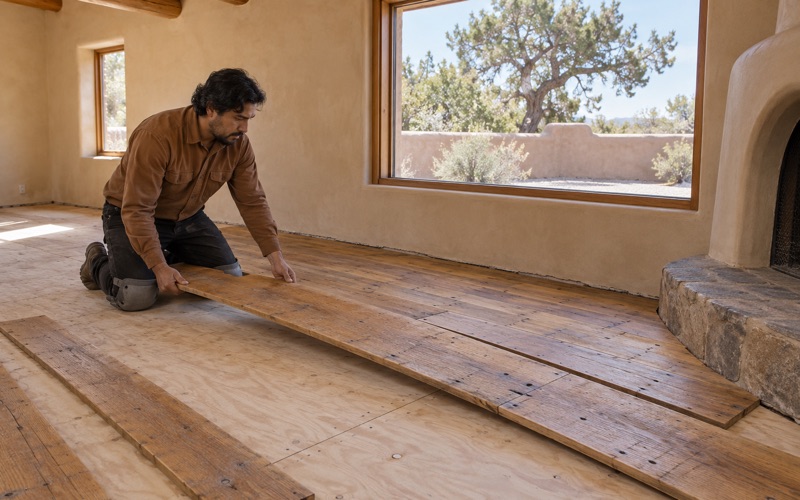
Reclaimed boards and wide plank pine get the same treatment. Wood milled somewhere wetter will shrink here, so we let it acclimate inside the house until the readings settle before it is installed. That step is what keeps wide boards from opening up in their first winter.
Old heat openings and tile edges
Older houses often carry the marks of earlier heating: an abandoned floor furnace grate or the holes left by a wall heater. We patch those openings with boards woven into the surrounding floor, staggering the joints so the repair blends into the existing layout instead of showing as a square filler piece.
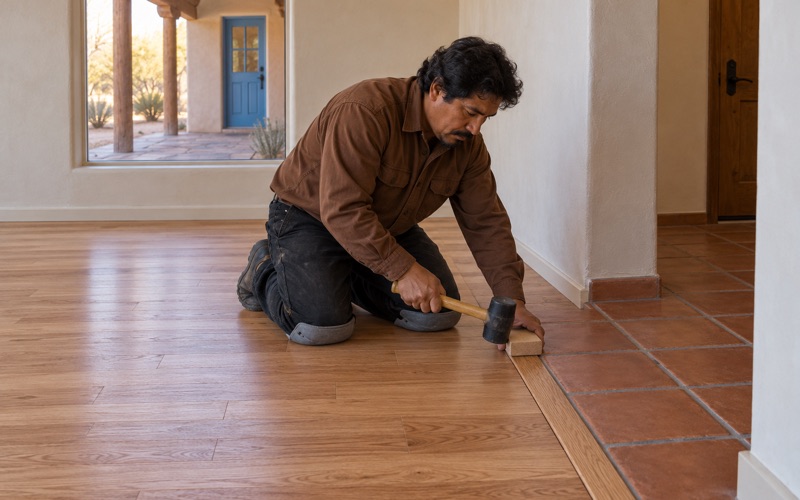
Where wood meets Saltillo tile, brick or flagstone, we plan the transition before installation. That may mean a flush joint, a reducer strip or a T-molding, chosen so there is no lip to catch a toe and no gap to collect grit at the doorway.
Lead-safe sanding
Houses built before 1978 may have old coatings that contain lead. Before we sand any old finish in a pre-1978 house, we follow lead-safe work practices under the EPA Renovation, Repair and Painting rule: containment, a dustless sanding system on the drum sander and edger, and careful cleanup. For the new finish, we choose products that meet the federal VOC limits in 40 CFR 59 Subpart D, with low-odor waterborne polyurethane or a hardwax oil finish for families who are staying in the house during the work.
Planning a Floor Project in Agua Fria
Every project starts with a visit to the house. We walk the rooms, take moisture readings in the wood, the subfloor and any concrete, and write them down before anything is ordered. You get the readings along with the estimate, so the numbers behind the recommendation are on paper.
What the estimate covers
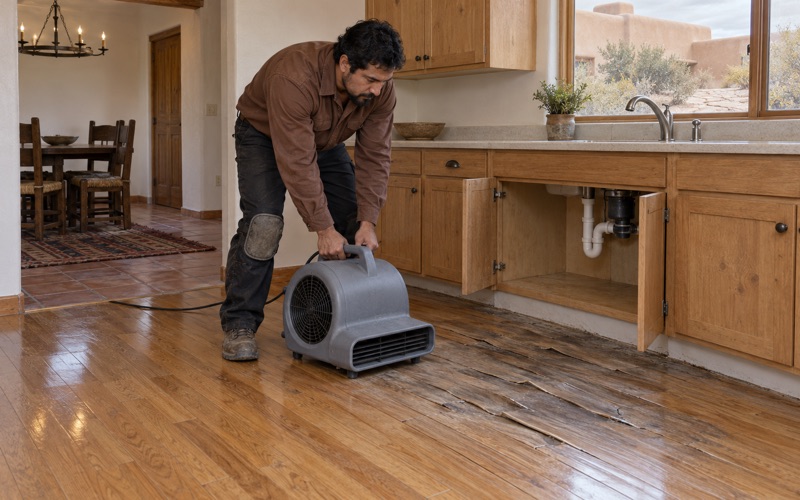
Our estimates are itemized: material, subfloor work, installation or sanding, the grit sequence and number of finish coats, transitions, and any board replacement. If the job is a repair after a leak, we trace the water to its source first, including a leak in a radiant heat line, and document the damage with photos and moisture readings an insurance adjuster can use.
Weather and timing
Agua Fria sits in the National Weather Service Santa Fe Metro Area forecast zone. Seasonal changes in the weather move indoor humidity, so we time acclimation and finishing around the readings in your house rather than the calendar. A waterborne finish usually lets a room return to light use sooner than an oil-modified one, and we tell you in writing when furniture can go back.
During the work
We protect the rooms we are not working in, keep dust down with vacuum-connected sanders, and leave the house swept at the end of each day. On a refinish, we check each room under raking light before the first coat goes on, because a sanding mark caught then costs minutes and one caught after the last coat costs a day. If we find something under the old floor that changes the plan, such as a soft subfloor, we stop, show you, and put the change in writing before continuing.
If your floor is in a newer home that needs an upgrade, a rental between tenants, or an older village house that deserves careful repair, the first step is the same. Call Santa Fe Wood Flooring to set up a visit, and we will measure, explain what we find and give you a written plan for the work.
- 20+ Years Experience
- Written Moisture Readings
- Itemized Written Estimates